Ads used to be here |
 |
 |
 |
 |
 |
 |
 |
 |
 |
|
|

 |
|
|

| Life |
|
Art
& Culture Feng
Shui with Horoscope Almanac Mind, Body & Soul Style |
|
Cloisonne Art Treasures Shopping!
View items from
China 2000 Collection and
It is believed that missionaries passed cloisonne enameling onto China from central Asia. Once the skill of manufacturing enamel products was mastered, the Chinese constantly improved and enhanced the technique, making it distinctly Chinese art. During the mid-15th century reign of Ming Emperor Ching T'ai, cloisonne production was extremely prosperous - many cloisonne works of the most delicate quality were produced. These works were fused with a kind of special blue enamel as the base color, hence the term for cloisonne in Chinese: ching-t'ai-lan. China possessed excellent conditions for developing cloisonne-enameling art - it already had metallurgical technology, such as bronze casting; glass and glaze production techniques, and the knowledge of accurately controlling firing temperature. Cloisonne also has properties that are a part of the Chinese loveof beauty. For instance enamel is as soft and smooth as jade, as glittering as jewelry, and as delicate as china.
After firing, the surface of the object was polished smooth so that the soldered brass wire pattern and the enamel substance were melded into one. The last step was to gold plate the exposed brass wires between the pattern as well as the rim and the bottom of the object. An exquisite piece of cloisonne must have colors that are moist and glossy, fresh and bright, a body that is substantive and sturdy, a wire inlay that is neat and well-proportioned, and gold plating that glitters. Its delicate appearance and splendid patterns should emit classical warmth that rivets the gaze.
- by Frank Jang, Asian art and furniture historian and importer Shopping! View items from AsianConnections Collection!
|
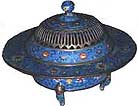 Cloisonne, the ancient Asian art of enamelware, dates back to the
Yuan Dynasty (1271-1368). Cloisonne is the decorative art of applying
enamel of all colors to the surface of a copper or bronze object,
which is then fired to become a bright and colorful work of art.
Cloisonne, the ancient Asian art of enamelware, dates back to the
Yuan Dynasty (1271-1368). Cloisonne is the decorative art of applying
enamel of all colors to the surface of a copper or bronze object,
which is then fired to become a bright and colorful work of art.
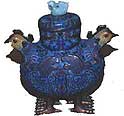 The production of cloisonne was a long and tedious process of developing
the design by soldering brass wires to the surface of a copper object,
then according to the requirements of the pattern, colored enamels
were filled in. After the spaces delineated by brass wires on the
copper object were filled in with enamel paste, the object was fired.
After every firing, the enamel contracts, producing an uneven surface.
It was then necessary to fill in the uneven places with enamel of
the same color many times over until every filled-in space became
thoroughly smooth. Only then was the firing process complete.
The production of cloisonne was a long and tedious process of developing
the design by soldering brass wires to the surface of a copper object,
then according to the requirements of the pattern, colored enamels
were filled in. After the spaces delineated by brass wires on the
copper object were filled in with enamel paste, the object was fired.
After every firing, the enamel contracts, producing an uneven surface.
It was then necessary to fill in the uneven places with enamel of
the same color many times over until every filled-in space became
thoroughly smooth. Only then was the firing process complete.
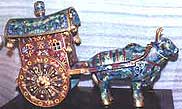 In recent years, this kind of traditional artwork has once again
drawn public notice and is highly valued. Many artisans are now
using modern machines and industrial technologies, and fusing them
with artistic creativity, to produce a variety of cloisonne ornaments,
art works, and household utensils that are elegant beyond compare.
This allows the integration of these kinds of traditional art works
into our modern daily lives. Cloisonne art enriches and embellishes
our homes, and is beautiful and loved as ornamental jewelry.
In recent years, this kind of traditional artwork has once again
drawn public notice and is highly valued. Many artisans are now
using modern machines and industrial technologies, and fusing them
with artistic creativity, to produce a variety of cloisonne ornaments,
art works, and household utensils that are elegant beyond compare.
This allows the integration of these kinds of traditional art works
into our modern daily lives. Cloisonne art enriches and embellishes
our homes, and is beautiful and loved as ornamental jewelry.
 |
|||
|
 |
|
|
| | About Us | Disclaimers and Legal Information | Advertise With Us | We welcome your comments. Send e-mail to us at info@asianconnections.com Copyright ©1999-2002 AsianConnections.com |