Ads used to be here |
 |
 |
 |
 |
 |
 |
 |
 |
 |
|
|

 |
|
|

| Life |
|
Art
& Culture Feng
Shui with Horoscope Almanac Mind, Body & Soul Style |
|
Shopping!
View items from China
2000 Collection and
First, it's value lies in its scarcity. Precious stones are formed over long geological epochs and are hard to get - especially green jade, white jade and agate. Ancient people on a treasure hunt had to trek on the back of yaks in mountainous regions to get at the uncut rocks containing the gems, exposed or half exposed, by the stamping of animal's hoofs. Sometimes, precious stones were washed down by mountain torrents and were discovered by men with a sharp eye and more than a little luck. In any event, exposed stones grew scarce and people began to bore through the mountains to mine for precious stones, making them even more challenging to obtain. Second, the value of jade lies in its hardness. Precious stones are divided by their hardness into two major groups, jadeites and nephrites. Jadeites are the ones with a solid texture and a hardness of degree 6 or more (on the basis of 10 for a diamond). The more valuable varieties, such as green jade, may be as hard as degree 8 or 9. Jadeites are invulnerable to steel cutting tools made of carborundum or diamond power. Objects made of this hard jade are smooth, lustrous, glittering and translucent, and their grains are no longer visible to the naked eye. Third, the value of precious stones lies in their natural color and hue. Some are as white as snow, others are bright red, and still others alluringly green. Some stones carry an array of colors, which a master artisan can use to good effect. Even flaws in the stone can be turned into "beauty spots."
Today, traditional forms and modern styles are combined into striking new creations, and modern technology has greatly elevated the quality of workmanship. No longer is jade for the exclusive use of emperors and noblemen; just about everyone can own or wear a piece of jade. Jade remains an eternal symbol of China's magnificent civilization, but the master carvers and quality jade stones are becoming very rare. Now is the time to acquire a jade treasure that can be passed on to the next generation. - by Frank Jang, Asian art and furniture historian and importer
|
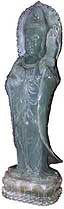 "There is
a price for gold, but no price for jade," says a Chinese proverb.
That's why jade ware is often described as "worth a string
of towns." Chinese consider jade to be "the essence of
heaven and earth." How is it that jade is so valuable?
"There is
a price for gold, but no price for jade," says a Chinese proverb.
That's why jade ware is often described as "worth a string
of towns." Chinese consider jade to be "the essence of
heaven and earth." How is it that jade is so valuable?
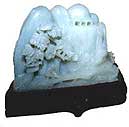 In Chinese culture,
jade symbolizes nobility, perfection, constancy, and immortality.
For millennia, jade has been an intimate part of the lives of Chinese.
Jade is viewed as an ideal gift for couples making a mutual commitment,
particularly for one's children when they get married. It is viewed
as the most valuable of all precious stones.
In Chinese culture,
jade symbolizes nobility, perfection, constancy, and immortality.
For millennia, jade has been an intimate part of the lives of Chinese.
Jade is viewed as an ideal gift for couples making a mutual commitment,
particularly for one's children when they get married. It is viewed
as the most valuable of all precious stones.
 |
|||
|
 |
|
|
| | About Us | Disclaimers and Legal Information | Advertise With Us | We welcome your comments. Send e-mail to us at info@asianconnections.com Copyright ©1999-2002 AsianConnections.com |