|
Fruits
& Vegetables
|
Asian Eggplant | Asian
Pear | Bean Sprouts | Bok
Choy |
| Chinese Broccoli | Chinese
Chives | Chinese Okra |
| Chinese & Japanese Turnips | Chili
Peppers | Cilantro | Ginger
| Jicama |
| Kumquat | Lemongrass
| Mushrooms | Napa Cabbages | Pomelo
|
| Snow Peas | Taro Root
| Thai Sweet Basil | Winter
Melon | Yard Long Bean |
From
Martin Yan's book - A Simple Guide to Chinese Ingredients &
Other Asian Specialties - your gift with every online
purchase of Yan Can Cook books and products.
|
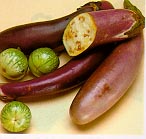
Asian
Eggplant
Aike
Gwa; Chieh Tzi
(Japanese) Nasubi
|
There
are several popular Asian eggplants, including the Chinese,
Japanese and Thai varieties. Chinese and Japanese eggplants
range in size from short and pudgy 3 inches to thin and slender
9 inches in length. Chinese eggplants are white to lavender;
Japanese varieties are light purple to purple-black. Thai
eggplants come as small as peas to as large as golf balls.
Their skin color ranges from white to lime green with some
striped and others solid. Under the skin, however, most varieties
are pretty much alike, and with the exception of Thai eggplants,
can be used interchangeably in most recipes.
Asian
eggplants are sweet and relatively seedless, and do not need
to be salted, soaked, or peeled. Cut them in half lengthwise
or fan cut to grill; for stir-fried or braised dishes, they
can be roll cut, sliced, or cubed. Cooked Thai eggplants are
used in curries; and also uncooked in chili sauces or pickled.
Choose
firm, smooth, unblemished Asian eggplants. They are best when
used the day of purchase but can be wrapped in plastic wrap
and refrigerated for up to several days.
|
|
--
back to top --
|
|

Asian
Pear
Ah
Tzou Suet Lay; Ya Chou Hsueh Li
|
Juicy
like a pear, crisp like an apple, Asian pears, also called
apple peas, are the oldest cultivated pears known. They have
the squatty look of an apple, a sandy texture, and a speckled
yellow green or light brown skin of a pear. Generally they
are blander in flavor than European pears.
Most people
prefer peeling the edible skin of the Asian pear before eating
the fruit. Cut it into wedges, matchstick pieces, or dice
and eat as is or in mixed salads and deserts. No matter how
you prepare the fruit, it will make a refreshing treat any
time of the day.
Asian
pears are available from summer through fall. Rather than
being stacked as most apples and pears are, Asian pears are
nestled in foam nets to prevent the delicate fruits from bruising.
Choose firm, fragrant Asian pears. Unlike most other pears,
Asian pears are ripe even when they do not yield to pressure.
Store at room temperature for up to a week or refrigerate
for up to a month.
|
|
--
back to top --
|
|
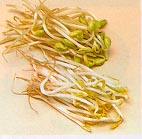
Bean
Sprouts
Look
Dou Ah; Lu Tou Ya
( Japanese) Moyashi
|
Fresh
bean sprouts, both mung and soy, have bright silver white
bodies with yellow heads and long tails. Soy bean sprouts
have larger heads and are more crunchy.Fancy restaurants typically
remove the head and root portion from the sprouts before cooking
to give dishes a clean look but both the head and root are
completely edible and are quite nutritious.
Asians
prefer eating bean sprouts stir-fried or boiled with very
little seasoning. Try tossing bean sprouts in noodle dishes
and fresh salads. Just rinse them with water to clean and
remove any unwanted woody green seed hulls before using.
Choose
dry, firm, unbroken white bean sprouts. Mung bean sprouts
are available in all supermarkets but soy bean sprouts may
be a bit harder to find. Sprouts are best used the same day
of purchase but they can be refrigerated in a plastic bag
with its end opened for up to a couple of days.
|
|
--
back to top --
|
|
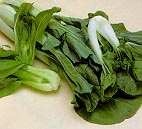
Bok
Choy
Boy
Choy; Pai Tsai
|
Bok
Choy is a loose-leafed cabbage with thick white stalks and
dark green leaves. The 7 to 9 inch stalks are mildly tangy
and crunchy; leaves are peppery and soft. Baby bok choy is
a smaller, younger version of bok choy. Shanghai baby bok
choy is another variety which is jade green with spoon-shaped
stalks and curved leaves. Both baby and Shanghai bok choy
are sweeter and less fibrous than regular bok choy.
All types
of bok choy are delicious when lightly stir-fried or boiled.
Trim the stem end and diagonally slice the large stalks. Leave
baby versions whole, or cut in half or quarter. Serve with
light sauces that accent the vegetable's natural sweetness.
Choose
bok choy with firm stalks, bright color,and no blemishes.
Baby and Shanghai boy choy are sold individually or in small
bunches. Refrigerate all types for up to a week.
|
|
--
back to top --
|
|
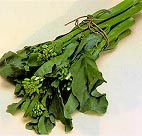
Chinese
Broccoli
Gai
Lan; Chieh Lan
|
Chinese
broccoli doesn't look anything like the regular broccoli found
in most supermarkets. It has thin, dusty green stems, deep
green leaves, and tiny white flowers. When cooked, the tender
stems and leaves have a slight bitter-sweet taste.
Steamed
Chinese broccoli seasoned with oyster-flavored sauce is a
popular Chinese favorite. Unlike regular broccoli, Chinese
broccoli stems are usually tender and do not need to be peeled,
however, if the stems are thick and appear tough, peel the
outer layer before cooking. When stir-frying or boiling, cook
the stems first, then add the more delicate leaves.
|
|
--
back to top --
|
|
Chinese
Chives
Gou
Choy; Chiu Tsai
|
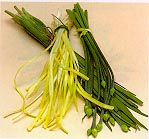
There
are several varieties of Chinese chives used in Asian cooking.
Green chives look like wide, 9-inch blades of grass. Yellow
chives have shorter, less fibrous leaves and a mild onion-garlic
flavor and aroma. Flowering chives are 11 to 12 inches in
length and have firm stalks with small edible flower buds
at the tips.
Cut Chinese
chives into 1.5-inch pieces and add to any dish. Try combining
yellow chives with tossed noodle dishes, flowering chives
with marinated beef to make a tasty stir-fry, and minced green
chives in steamed dim sum.
Chinese
chives are available in bunches only during the spring and
summer seasons. To store, wrap the chives with a damp paper,
place them in a plastic bay, and refrigerate. The chives will
keep for several days; their flavor becomes stronger over
time.
|
|
--
back to top --
|
|
Chinese
Okra
See
Gwa; Ssu Kua
|
You
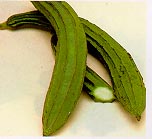
can't miss Chinese okra. It is the funny looking vegetable
with long, bumpy ridges that flow from top to bottom. It has
a dull green color and a spongy zucchini-like inner texture.
The taste and texture is similar to common okra, but without
the thickening qualities.
Before
using Chinese okra, peel the bitter, bumpy ridges, then thinly
slice or roll cut. Add to stir-fries, soups, or braised dishes.
Choose
small Chinese okra, as larger ones tend to be older and more
fibrous. They should be firm and unblemished. Refrigerate
Chinese okra for up to a week.
|
|
--
back to top --
|
|
Chinese
and Japanese Turnips
Law
Bok; Lo Po
(Japanese) Kabu
|
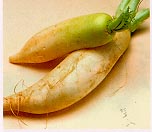
Chinese
and Japanese turnips look like over-sized carrots. They range
in size from 8-14 inches long, 2 to 3 inches wide, and have
a grayish white color. The Japanese variety is also known
as daikon or giant white radish. Although there are many varieties,
they all taste sweet and peppery.
The white
turnip is a staple in Chinese, Japanese and Korean cooking.
Among other uses, Japanese cooks finely shred the turnip and
serve it in salads or as an accompaniment to sashimi. Chinese
cooks cut it into small chunks and add it to stews. Korean
cooks pickle the turnip to make kimchee and other side dishes.
Chinese and Japanese turnips can be peeled before cooking,
as the skin can be bitter and tough.
Choose
a turnip that is short with a firm, smooth surface. Longer
turnips tend to be older and more fibrous. To prevent moisture
loss, wrap the turnip in plastic wrap and refrigerate. It
will keep for a couple of weeks.
|
|
--
back to top --
|
|
Chili
Peppers
(Fresh)
Seen Laut Tziu; Hsien La Chiao
(Dried) Laut Tziu Gon; La Chiao Kan
|
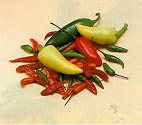
Dozens
of chilies, both fresh and dried, are an important flavoring
agent in many regions in China and in most Southeast Asian
countries. Red or green, use whatever variety you like. In
general, the smaller the chili, the hotter it is. The tiny
1-1/2 inch Thai bird chili is one of the hottest available.
The slightly larger serrano is just a bit milder, followed
by the broad shouldered jalapeno and the 5-inch Anaheim which
still has a gentle kick.
Whole
dried red chilies are small, deep red, and fiery hot. use
whole or break into smaller pieces. Crushed red pepper flakes,
which are chopped whole dried red chilies, are a bit hotter
since the seeds and veins are exposed. Buy whole and crushed
chilies that are bright red. Remember to wash your hands after
handling any chili; their oils may burn or irritate your skin.
Store
fresh chilies in a paper bag.
|
|
--
back to top --
|
|
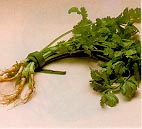
Cilantro
Yim
Sike; Yuan Chien
(Thai) Pak Chi
|
Cilantro,
also known as fresh coriander or Chinese parsley, is one of
the most common fresh herbs used in Asian cooking. It is delightfully
aromatic and has a distinct, refreshing flavor. Don't confuse
cilantro with wide, flat leaves.
The Chinese
use cilantro as a garnish and to flavor soups, salads, dim
sum stuffings, and steamed fish. Thai cooks crush cilantro
roots and stems into curry pastes and chili sauces and use
the leaves in salads. If you find cilantro with its roots
intact, use the leaves, stems and roots for a more concentrated
flavor.
Choose
bright, perky bunches of cilantro with fresh crisp leaves
and stems. To store, stand cilantro in a glass of water, loosely
cover the tops with a plastic bag, and refrigerate for up
to several days.
|
|
--
back to top --
|
|
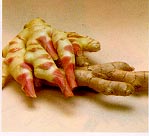
Ginger
Geung;
Chiang
(Japanese) Shouga
|
In
Chinese and Japanese cooking, there is no substitute for fresh
ginger. Its spicy bite and tantalizing aroma enhance almost
every kind of dish. Ginger looks like a knobby hand with shiny,
smooth, golden skin and a fibrous, yellow-green interior.
Young ginger or baby ginger is immature when harvested and
has a smoother, more delicate flavor and a less fibrous texture.
For aesthetic
reasons, many cooks peel ginger before using, although it
is not necessary. Thin-skinned young ginger does not need
to be peeled. Slice, julienne, mince, or grate ginger and
use it to season meats, poultry, seafood, and vegetables dishes.
Choose
ginger that is hard, heavy, and free of wrinkles and mold.
Ginger is available all year round, but young ginger is available
only during the summer and fall seasons. Store mature ginger
in a cool, dry place for up to a couple of weeks or peel,
place in a jar of dry sherry, and refrigerate for up to several
months. Refrigerate young ginger for up to a week.
|
|
--
back to top --
|
|
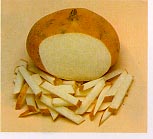
Jicama
Sa
Gog; Sha Chiao
|
Jicama
looks like the world's largest turnip, with a tan, leathery
skin and crunchy, slightly sweet, white flesh. This root vegetable
is quite unique for its ability to retain a refreshing crisp
texture even after cooking. Although a bit more fibrous and
not as sweet tasting, it is a good substitute for fresh water
chestnuts.
Jicama
may be eaten raw or cooked, but it must be peeled first. Use
a sharp paring knife to remove the tough skin. Cut the flesh
into matchstick pieces or small chunks and use in salads,
stews, and stir-fried dishes.
Choose
small, firm, well-rounded jicama that are free of blemishes
and mold. Some supermarkets sell quartered or halved jicama
wrapped in plastic -- a real convenience if you don't need
a large piece. Refrigerate uncut pieces for up to several
weeks. Wrap cut jicama in plastic wrap and refrigerate for
up to a week.
|
|
--
back to top --
|
|
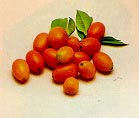
Kumquat
Gum
Quat; Kan Chu
|
You
probably have seen kumquats in the supermarket and didn't
even know what they were. They come in a variety of colors,
shapes, and sizes from bright orange to golden yellow, round
to oval, and 1 to 1.5 inches in length. The kumquat is completely
edible with most varieties having a sweet peel and sweet-tart
pulp. Some of the Japanese varieties have a sour tasting flesh.
Garnish
a platter with whole or sliced kumquats or use them to top
sweet desserts. Use the kumquat peel as you would orange and
lemon peels. Kumquats are also available preserved in syrup
and candied. These sweet treats, found during the Chinese
New Year, symbolize good fortune.
Kumquats
are seasonal and are available only from October through May.
Choose those that are firm with a smooth, shinny, even color.
They are best when fresh, but they can be refrigerated for
up to a couple of weeks.
|
|
--
back to top --
|
|
Lemongrass
Heung
Mao; Hsian Mao
(Thai) Takrai
|
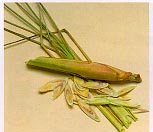
Lemongrass
looks like a very long, woody green onion that's pale yellow-green
in color. When cooked, lemongrass imparts a delicate lemony
flavor and aroma. It is a classic ingredient in many Southeast
Asian countries including Indonesia, Malaysia, Thailand, and
Vietnam.
Only the
moist portion of lemongrass, the bottom 6-inches, is suitable
for cooking. Discard the top and remove the fibrous layer
on the bottom portion if it looks dry. Use lemongrass to flavor
soups, stews, curries, and stir-fries. For soups, gently crush
the stalk and add it whole; slice, dice or mince it for other
cooking. When used whole or in large piece, it is best to
remove lemongrass before serving as it tends to become stringy
during cooking. When using dried lemongrass, soak it in warm
water until softened. If lemongrass is not available, substitute
1 teaspoon fresh lemon peel for one stalk lemongrass.
Fresh
and dried lemongrass are available in Asian markets. Wrap
fresh lemongrass in paper towels and refrigerate for up to
2 weeks or freeze for up to a month.
|
|
--
back to top --
|
|
Mushrooms
Seen
Gu; Hsien Ku
(Japanese) Nama-Shiitake
|
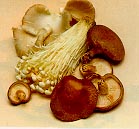
Mushrooms
have long been considered a delicacy in Asian cuisines. There
are several types of mushrooms that are especially popular:
the delicate, shell-shaped oyster mushroom, the long-stemmed,
tiny-capped enoki mushroom, and the fir, golden brown shiitake
mushroom. Oyster mushrooms and enoki mushrooms have a mild,
delicate flavor; shiitake mushrooms have a rich, meaty flavor.
All are smooth and velvety in texture.
Before
using the mushrooms, trim off the knobby, woody stem ends.
Stir-fry whole oyster or shiitake mushrooms with vegetables
or thinly slice and saute. Garnish light soups and fresh salads
with a small bunch of enoki mushrooms.
Most mushrooms
are available in plastic packages and in bulk. Choose mushrooms
that are firm, dry, plump, and free of blemishes. They are
best used the day of purchase but will keep for several days
if removed from their packages, placed in a paper bag, and
refrigerated.
|
|
--
back to top --
|
|

Napa
Cabbage
Siu
Choy; Shao Tsai
(Japanese) Hakusai
|
Two
types of napa cabbage are commonly available: the short, football-shaped
Chinese napa cabbage, and the tall, bouquet-shaped Japanese
napa cabbage. Both have sweet, creamy white stalks with frayed,
ruffled, pale green edges.
Napa cabbage,
also called celery cabbage, can be used in the same way as
regular cabbage, but because it is more tender, you need to
decrease the cooking time. Cut the stalks into small pieces
and stir-fry until crisp-tender. Add thinly sliced napa cabbage
to soups and cook until translucent and silky textured.
Although
the Chinese and Japanese napa cabbages are seasonal, one of
the two is likely to be available throughout the year. Choose
cabbages with moist, pale green leaves with no browned edges.
Ignore the black spots found on the base as they are the result
of unpredictable growing conditions. Both varieties of napa
cabbage will keep in the refrigerator for a couple of weeks.
|
|
--
back to top --
|
|
Pomelo
Sa
Tin You; Sha Tien You
|
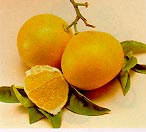
If
you've seen a very large, pear-shaped, yellow grapefruit,
then you've seen a pomelo, also know as Chinese grapefruit.
It has a thick, fragrant peel, and a sweet, dry pulp that
is much different from other citrus fruits. the thick membrane
surrounding the pulp is inedible and must be removed.
To eat
a pomelo, remove the thick peel and membrane and pull apart
the sweet pulpy sections. Eat it out of hand or add it to
crunchy salads. Dry the peel and use it in soups to add a
light citrus fragrance. During the Chinese New Year, you may
see pomelos in window displays as they symbolize continued
good fortune and prosperity.
Pomelos
are available from January through March. Choose fruits that
are fragrant and heavy. Refrigerate ripe pomelos for up to
a week; let the unripe ones sit on the counter until slightly
softened.
|
|
--
back to top --
|
|

Snow
Peas
Hor
Lan Dou; Hsueh Tou
|
Snow
peas are flat pea pods with a sweet sugary flavor and crisp,
crunchy texture. Unlike English peas which must be shelled
before cooking, bright green snow peas are completely edible.
They are excellent in stir-fries, salads, and soups.
To use,
snap off the stem ends and remove the fibrous strings that
run along the sides. Boil, steam, or stir-fry until crisp-tender,
and add to any dish that needs green accents or texture. To
make snow peas more decorative, cut them in half diagonally
or cut out a tiny triangle from the stem ends.
Be sure
to pick young snow peas which are bright green, flat, crisp,
and free of blemishes. Avoid wilted, thick-skinned, overly
plump, and discolored peas as they are too mature and more
fibrous. Snow peas will keep in the refrigerator for a week.
Frozen snow peas are available but are not recommended.
|
|
--
back to top --
|
|
Taro
Root
Woo
Tou; Yu Tou
|
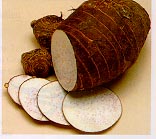
There
are many types and sizes of taro root including the large
melon-sized taro and the small golf ball-sized taro. All are
somewhat hairy, dark-skinned, and rough textured on the outside.
The flesh of some varieties turns from white or grayish to
light purple when cooked. Starchy in texture, cooked taro
root is sweet and nutty in flavor.
Before
using, taro root must be peeled and cooked to become edible.
Wear rubber gloves when peeling taro root, as the juices may
irritate your skin. Use the root as you would use potatoes.
Shred taro root and deep-fry to make an edible basket. Boil
or steam taro root and blend into stuffings. Cut it into chunks
and add to stews and braised dishes. As with potatoes, taro
root goes well with rich seasonings and sauces.
Look for
firm taro roots that are free for dents, wrinkles, blemishes
and mold. Store taro roots in a cool, dry place. They will
keep for a week.
|
|
--
back to top --
|
|
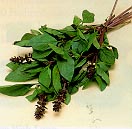
Thai
Sweet Basil
Tai
Guok Tim Law Log;
Tai Kuo Tien Lo Le
(Thai) Bai Horapa
|
For
those of you who enjoy the slightly strong, yet sweet lingering
flavor of anise, you must try this fresh herb. It plays an
important role in Thai and Vietnamese cuisines. Thai sweet
basil has bright green leaves with purplish green stems and
flowers. It has an aromatic anise fragrance and flavor.
Use Thai
sweet basil as you would other fresh herbs. Toss whole leaves
into salads or add to stir-fried dishes. Stack a few whole
leaves on top of each other and roll into a bundle. Turn the
bundle sideways and thinly slice to make fine shreds. Use
shreds to garnish soups and sauces. Pound chopped basil into
curry paste, or serve whole trimmed bunches as an accompaniment
to Vietnamese noodle soup. Just pluck the leaves from the
stem and drop them into the fragrant hot broth.
To store
Thai sweet basil, place stem ends in a glass of water, cover
with a plastic bag, and refrigerate. It will keep for several
days, but it is best when used the day of purchase.
|
|
--
back to top --
|
|
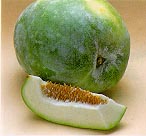
Winter
Melon
Doan
Gwa; Tung Kua
|
If
you ever saw a winter melon, you might have thought it was
a dusty, old green pumpkin. It is a pretty interesting looking
vegetable with the entire surface covered with chalky white
bloom. Inside is a tangled web of seeds which must be removed
before cooking. The inner flesh is pale green to milky white
in color with a faint sweet-peppery taste.
Winter
melon is never eaten raw. Remove the seeds and rind, thinly
slice, and steam or simmer in soups. Because it has a relatively
bland flavor, winter melon is typically paired with flavorful
ingredients, such as dried shrimp, and dried black mushrooms
in soups and stir-fried dishes.
Winter
melons can weigh from 8-10 pounds and be 12-15 inches tall.
Because of their huge size, most Asian markets cut them before
selling to their customers. Store an uncut melon in a cool,
dry place for up to a month. Wrap cut melon in plastic wrap
and refrigerate for up to several days.
|
|
--
back to top --
|
|
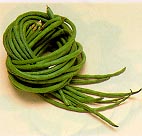
Yard
Long Beans
Dau
Gog; Tau Chiao
|
The
yard long bean isn't one yard long, but it can grow to a length
of 18 inches. It's sort of like the story about the fish that
got away. They are pencil-thin beans with smooth, somewhat
bumpy surfaces. Their color ranges from pale green to dark
green. When cooked, long beans have a sweet flavor and a dry,
crunchy bite unlike other string beans with are juicy and
crisp.
Trim the
stem ends of the beans before cooking -- notice there's no
fibrous strings to remove. Cut long beans into 1/2-inch, 1-inch,
or 2-inch pieces and stir-fry. For a fancier presentation,
cut long beans into 6 to 8 inch lengths, blanch until softened,
and tie each into a knot. Serve the long bean knots as a side
dish with roasted meats and poultry.
Yard long
beans are found tied in bunches. Although they are available
all year around, they are at their best during the summer
season. Buy young beans which have few blemishes and wrinkles.
Older beans, which tend to be longer, are tough and fibrous.
Yard long beans will keep in the refrigerator for a week.
|
|
--
back to top --
|
|