| |
An Appetite for Road Food on the Backroads
of Northern China
by
Carla King
Every time I stopped for more than five minutes, crowds of people
would gather around. I didn't blame them. China had just opened
up to "free travel" and they'd never seen a foreigner up close before,
not to mention a blond American woman riding a motorcycle alone
through the completely untouristed countryside. Sometimes it was
fun, other times it was annoying. So what to do when I was hungry?
Road food was the answer. In minutes I'd have a hot, tasty, and
nutritious meal, and if I became claustrophobic I could always just
pack the food and ride away. It wasn't always like that though.
Here are some food highlights from the china road: http://www.chinaroad.org
journey in Spring of 1998, which, with the fresh vegetables and
abundant harvest, was a great time to be sampling food from roadside
stands.
Beijing
On my first day in Beijing Teresa and I were motorcycling through
streets filled with what seemed like all of its 11 million inhabitants.
Our destination was the Dirt Market, "the quintessential Beijing experience,"
she insisted. I followed, grateful for a guide through the confusing
city, wondering why it was called the Dirt market? Did they sell dirt
there? No, it was simply located in a dirt lot, not yet asphalted
over like most of Beijing. There were lots of interesting and diverse
things to look at, but first things first, I was hungry! Teresa led
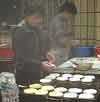
me to a stand where a woman poured batter onto a coal-heated iron
platter. In moments I was delivered a delicious scallion pancake wrapped
in newspaper. "Cleaner than a plate," said Teresa. "It's too bad most
tourists are put off, but this method is more sanitary than restaurant
plates."
Having eaten this way in Africa and Europe, I know that anything
cooked on the spot is "safe" food for a traveler with
unacclimated bacterial defences. Teresa, who had lived in Beijing
for three years, was delighted to find a willing culinary companion.
In the days that followed she seemed intent upon giving me a culinary
tour of Beijing street food.
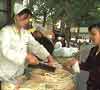
Whenever we saw a steaming stack of bamboo containers we'd exchange
equivalent of a few pennies for a handful of soft, white dumplings.
Inside might be a mixture of ground meat, bright green vegetables,
garlic and onions. Others contained chopped vermicelli - remember,
Marco Polo brought pasta from China - in a garlicky red sauce. Potstickers
were common too, steamed and then pan fried. Dessert was soft crumbly
almond cookies, some spread thinly with sweet red mung bean paste.
It was all clean, hot, nutritious, very cheap, and incredibly fast.
Another thing I loved was a bowl of hot freshly made noodle
soup. In Beijing, the chef stood outside amongst the picnic tables
frying meat and vegetables on a charcoal stove with the aplomb of
a gourmet. Ladelfuls of broth were dumped into the wok and tilted
toward the fire until the mixture flamed. On a wooden counter lining
a shack that held used bicycle parts, a man hand-kneaded pasta dough
made from flour, water and salt. When it was ready he brought it
to the wok and took a large, sharp cleaver to the dough, shaving
off noodle-shaped pieces into the boiling broth faster than you
could see it happening.
To
Heibi Province: My first day in the countryside
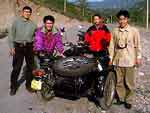
The four Chinese motorcyclists that formed my sendoff party over the
mountains from Beijing to Heibi province swerved off the road to a
white-tiled building. I didn't realize it was a restaurant until we
walked inside, and in fact I would never be able to recognize the
characters for "restaurant" or "hotel" for the
duration of my trip! It was quite gourmet and frequented by tourists
headed to a nearby Ming village. We'd visit it too, that is, if we
didn't explode first from stuffing ourselves silly. One dish was piled
with slender green tree branches battered and quickly fried, like
tempura. A spring specialty of the area, it was explained. (Later,
in the country, I would see peasants gathering these young, tender
branches.) But my favorite dish was a big bowl of peeled and steamed
white potatoes served alongside a red-hot bowl of caramelized sugar,
and yet another bowl of ice water. The procedure? Pick up a potato
with your chopsticks, dip it into the caramelized sugar and then immediately
into the bowl of cold water. The caramel crackles and cools enough
to eat and it is an amazing combination and so easily prepared that
just from this description you can prepare it at home!
In
the Wild Wild West
A week later I am a road food expert. I motorcycle through
villages, the air fresh from a recent light rain, catching the sweet-bread
smell of steaming dumplings here, the pungent pepper-soy scent of
potstickers there. My nose sniffs out the possibility of food: someone
is chopping onions and garlic, and down the alleyway there a tableful
of fruits. I know this from the tropical smell of bananas and Asian
pears. I am now fearless and have tried everything I've seen - eggs
boiled in soy sauce, their shells cracked to absorb the brown liquid;
nuts and raisins, candies made from cinnamon and cardamom, pastries
with mung bean fillings. Suddenly, near Inner Mongolia, I find cheese,
hard and white, from the sheep that roam the flatlands here.
After settling in a hotel I go for a walk in Dongsheng at dinnertime.
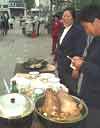
The city square is transformed into an impromptu food court with white
clothes and many vendors are selling hot foods, including the regional
specialty: huge potfuls of whole boiled sheeps heads. I choose small
things from here and there (not the sheeps heads), obtain a big bottle
of the regional beer (impressive!) and settle down at a table to watch
life pass by: bicyclists struggling under the weight of dozens of
fresh sheepskins, Muslim men from Kazakhstan hawking squewers of barbequed
mutton, taxis running red lights, and children racing between the
tables, screeching in some game of their own making.
In
a Buddhist Monastery
I feel very lazy because the monks won't let me lift a finger.
I watch as they bring a big wok of water to a boil, add the vegetables
and then the cut the noodles into it in small chunks, cover it,
let it simmer and then add soy sauce and salt, always too much salt
here. The three of us eat, they slurp loudly and correct the way
I hold my chopsticks. They finish, light cigarettes and I continue
to eat, picking at a pile of tomato and cucumber slices literally
covered in cilantro and sugar. One monk goes to answer a call that
came on his pager while the other two stay, rivited to a soap opera
playing on an old bluish television screen with the volume turned
nearly all the way up. The plot is simple, the star of this soap
has been unfaithful to her husband, she tearfully reveals a huge
hickey on her neck. The husband shouts and leaves, slamming the
door behind him. The woman cries. The monks smoke furiously.
The
Middle of Nowhere
When it is time to prepare for dinner I am banned from both
the kitchens of my hostess and of the woman next door, who is the
wife of the welder in the town where I am stuck because of engine
problems. Tonight I will be treated to a banquet with the whole
town, population 12. Lily's two-year old girl and I make the rounds
between the houses and get in the way. Finally we sit. The menu
is:
Green stuff, brown stuff, pickled stuff, fatback and more
green stuff, rice and more green stuff with red peppers, cigarettes,
beer, green stuff with noodles, pickled brown stuff, cigarettes,
more beer, a plate of sliced tomatoes covered in sugar, a plate
of julienned cucumbers covered in sugar, a plate of what might be
julienned zucchini drowned in soy sauce, cigarettes, beer, a plate
of frozen meat sliced paper thin, hot bowls of rice, and lots more
cigarettes and Inner Mongolian beer.
We raise our glasses to drink and I involuntarily utter "cheers."
My hosts are delighted to learn the American toast, and it begins
a spate of drinking with the toast "chrews," which is
as close as they can come but shouted with gusto. Everyone seems
raging drunk after the first glass, but I chalk it up to the festive
atmosphere, and consider that this is heady stuff, this foreigner
thing... the first time anybody's ever seen one. We laugh a lot
about nothing, and they shout YES! and OKAY! for no reason. I yell
out the only Mandarin words I know, the phrase that means "I'm
lost!" and "Where's the bathroom." We laugh hysterically
at one anothers' pronunciation, and by the next day, I am family.
Three days later I my motorcycle is running good as new, and I am
sorry it didn't take longer.
Yinchuan:
City of Abundance
This morning Yinchuan seems like the Emerald city. A beautiful
clean city. Clean streets, clean air, light traffic. Heaven. I walk
to the department store and then to the shopping street and eat
noodles at a canvas covered food market with 50 woks all going at
once under canvas roofs, pots bubbling with meats and seafoods,
and squewers of quail eggs and triangles of marinated tofu. I sit
in the shade and drink sugared yogurt cream from a ceramic pot,
the straw is stuck through the tissue paper rubber banded over the
top; then a cup of eight-treasures tea with dried dates, apples,
a lump of rock sugar, and endless refills of boiling water. I have
listened to the theme of "Titanic" on loudspeakers coming
from every other store on the block, and I have not been crowded
around even one time thanks to the diversity of races here: Han
and Muslim and Tibetan. In a grassy little park where old people
practice Tai Chi and children play in a splashing fountain. It looks
a little like Italy, and the marketplace rivals any I've seen in
Europe. Fresh seafood has been flown in to this westernmost part
of China, live crabs squirm in wooden boxes, their legs wrapped
in seaweed. There are snakes and frogs and fish in well-aerated
aquariums. Rows of chickens ready for roasting are arranged in attractive
piles, some even have purple-blue skins. Brightly colored spices
are sold from large canvas bags, and vegetables are stacked neatly
by size and color. After a service at the local Buddhist monastery,
a monk gives me a banana and a steamed bun, freshly blessed by the
icon. Two Chinese servicemen in uniform photograph me in front of
the pagoda. At the hotel, I even have a glass of wine. I decide
that Yinchuan is my favorite Chinese city.
|