What's
So Special About Dragons?
By
Pang Jin
Dragons
appear throughout China. They are carved upon buildings, painted on
vases, used in dances, featured in Chinese movies and operas, and
even conversation. But how is it these exotic creatures have
become so closely intertwined with Chinese culture? Experts are still
not certain, and thousands of theories abound.
Origins
Dragons possess the best features of all the zodiac animals
- the deer's beautiful antlers that symbolize health and longevity,
fish tails that symbolize agility and zeal, powerful tigers' eyes,
lions' noses that symbolize wealth, horses' teeth that represent
hard work, oxen's ears, donkeys' mouth, snakes' bodies, and eagles'
claws.
Some say dragons are either descendants of a wild gulf crocodile
named Jiao or of snakes because of their snake-like bodies. Others
argue that dragons were either formed out of rising and twisting
clouds, unpredictable lightning, fish, or sea tides. Most believe,
though, that the dragon sprang from the curiosity andfear ancients
felt towards reptile such as crocodiles and snakes and natural weather
phenomena such as lightning and thunder showers. The earliest dragon
records date back to the late Paleolithic Period and the early Neolithic
Age. Back then, people believed all creatures had souls, and
most tribes had their own totem.
|
 |
 |
|
|
|
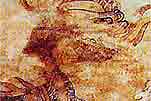
The
dragon in the Tang Dynasty (618-907) mural shows
features of different creatures..
|
|
|
The dragon is said to have separated earth from heaven, made all creatures
on the earth and have helped mankind reproduce.
According to one Chinese fairy tale, the first dragon's name
was Fuxi. Fuxi had a dragon's body and man's head. He wanted
to become the forefather of mankind but could not find a woman who
was able to bare him a son. So, he married his sister, Nuwa, who
then gave birth to the first group of men and women on earth.
In the stone carvings of the Han Dynasty, there are pictures
of Fuxi and Nuwa embracing each other, either with mascots in their
hands or with their two tails twisting together.
Fighting occurred after the birth of mankind. When
the fighting became fierce, the land fell into pieces. The well-known
Yellow Emperor also had a dragon's body and a man's head and so
some story tellers call him the Yellow Dragon. The Yellow Emperor's
brother, Emperor Yan, had the same mother but a different father.
He also had the body of a dragon. Some say the Chinese people are
descendants of the Yellow Emperor and Emperor Yan and are thus descendants
of dragons.
|
 |
|
|
Stone
carvings of Fuxi and Nuwa from the Eastern Dynasty
(25-220).
|
|
|
Symbols
There are both good and bad dragons. It is said that Nuwa
killed a black dragon on the Central Plain who always brought disasters
to the local people. Yu the Great slew a stupid dragon in
the Wuxia Gorge who had created a water channel in the wrong area.
But some dragons in Chinese folk tales are imagined to help kind
and poor people, drive away evil, and appear when on e is in trouble
- sort of like Superman in the United States.
Dragons are considered water gods because many of their zodiac
animal features need water to survive. Dragons are responsible for
administering water affairs and are said to exist in seas, lakes,
rivers, and springs. Whenever floods or droughts occurred, people
used to pray to dragons and offer sacrifices of pigs and goats.
Many dragon king temples still exit in China today.
Dragons also symbolize imperial power. Admiring their ancestors, later
Chinese emperors would compare themselves with the powerful creatures
and sometimes dress up like them. Since dragons are in charge
of water both in heaven and earth, they would report the conditions
of the earth to the celestial god, and then pass on orders to civilians.
The emperor is said to be the imperial dragon, the son of the celestial
god. His duty is to receive orders from heaven and to administer the
earth.
|
 |
|
|
Qing
Dynasty imperial robe with embroidered dragon patterns.
|
Many Chinese emperors associated themselves with dragons.
Emperor Qinshihuang of the Qin Dynasty (221-206 BC) was called the
ancestral dragon. Emperor Gaozu of the Han Dynasty is said
to be the son of his mother Liu Ao and the flood dragon. Emperor
Jingdi of the Han Dynasty once dreamed of a red pig turning into
a red dragon; afterwards, his son Emperor Wudi was born. When
Emperor Taizong of the Tang Dynasty was born, two dragons were said
to have been seen playing in the pool in Wugong County.
Since the emperors were considered dragons, special terms
were created to describe their activities. Regime conflicts were
called "dragon fighting," the beginning of a new imperial
regime was called "dragon's rising," and a crown prince
was called "a dragon in concealment." Once a prince
succeeded to the throne, he was called " a dragon in flight."
As the symbol of imperial power, the dragon often bears a
ferocious expression with bare fangs and brandished claws.
Living under the tyranny of imperial rule for so long, some people
became very passive - they obeyed rules, avoided conflict, and kept
away from imperial power.
Thus, when we see dragons carved or painted in imperial palaces,
although they are beautifully decorated in bright colors, they always
seem to keep a distance from the people.
Dragon
Dances
During important holidays and festivals, there are always
dragon dances.
The dragons are made of different materials including bamboo, wood,
straw, rattan, cloth, and paper. Sometimes, patterns of lotus flowers
and butterflies are put together to make the "Hundred-leaves
Dragon." People run, jump, and sing with the dragons as a prayer
for good harvest and luck as well as an amusement activity.
Working in the fields, Chinese farmers seldom had an opportunity
to relax and let themselves go. During the dragon dance, they
were free to perform all kind of movements. Also the dances posed
a good opportunity for young fellows to show off their abilities
to girls.
 |
|
|
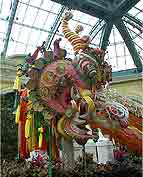
Dragon's
Head
Bellagio Hotel, Las Vegas.
|
Through the dragon dance people show their disrespect for imperial
power by pushing down its head, twisting its body, and grasping its
tail. The dance climaxes when on-lookers either throw firecrackers
at the dragon, or stuff its body with gunpowder and light it up. Fire
spews from its mouth and tail, and the creature crumbles.
Today, the dragon has lost a bit of mystique and has walked
into the lives of the ordinary people, making us feel closer to
it.
- Pang Jin
--------------------
AsianConnections.com
thanks China Today Magazine and Chinese dragon expert author PANG
JIN for permission to reprint this article. All photos are courtesy
of China Today, except "Dragon's Head" photographed by AC Team,
part of a full length Chinese dragon currently being exhibited during
the 2000 Millennium New Year's celebration in the lobby of the Bellagio
Hotel, Las Vegas, Nevada.
|