Ads used to be here |
 |
 |
 |
 |
 |
 |
 |
 |
| More Lia Chang |
| Interview with Justin Lin 02.03.2003 Interview with Ron Domingo Flower Drum Song: Making of the Cast Album Flower Drum Song: An American Story The Romance of Magno Rubio Mercedes Benz Fashion Week 2003 Documenting a Community on the Brink: New York Chinatown Post-September 11 The Notorious C.H.O. Part 2 A Look at Another Vietnam The Notorious C.H.O. Up Close and Personal with Margaret Cho The APEX of the Times MOCA Memories |
|
Amy
Tan at Ground Zero |
||
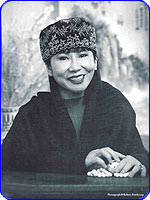
Amy Tan, the renowned novelist, was in New York City when all Hell broke loose on September 11. She had been in town, along with her husband, Lou DeMattei, and their two omnipresent Yorkies, to help promote Sagwa, the Chinese Siamese Cat, the PBS animated series based on her children's book. As with
the rest of the world, she was in for a shock. Hours after the
destruction of the World Trade Center, Amy, back in her loft
in the SoHo neighborhood, a short distance from lower Manhattan,
wrote about what happened in an e-mail to a number of friends,
among them AsianConnection's Ben Fong-Torres: "I was at the CNN building at Penn Plaza, scheduled to go on air�Suddenly, the newsroom erupted into chaos. That's when the plane hit the first tower. The news was on a dozen monitors in front of me and the actual news producers and assignment people around me were screaming who to dispatch, where, how. "More shouts and screams: The other tower was hit, then the Pentagon. After an hour, we left the building and went downtown toward the melee. That's when the second tower fell down. It was surreal, like a science fiction movie, people wandering by coated with building dust from head to toe, a dozen ambulances blaring by, expressionless faces, people crying, people running, mothers hugging children, others talking happily on the phone to say they are okay. "The streets along 6th and 7th Aves are lined with people staring downtown. No one knows what to do. We are just sitting here, safe, sound, but shaken like everyone else. "Take care, everyone." "Pray for our world."
The next day, with all telephone circuits to New York City jammed, Amy went online again. "The winds have shifted and the smoke from the fire have wafted into SoHo, bringing the reality of this tragedy closer to us," she reported. "It's a dusty, choking cloud. We are basically marooned, 15 blocks north of the disaster, 20 blocks south of the blockade. Police stand guard behind barricades and don't let anyone into SoHo but residents with proof. And even with proof, the police, who seem on edge and are exhausted, are not keen on letting anyone come into the area." "Lou, the dogs, and I went for a walk a short while ago to see if we could find a pharmacy to buy face masks. No such luck. At the Houston St. barricade we were told to get off Broadway because of a bomb scare, and then we had a difficult time trying to return to our loft. "SoHo has become a ghost town without traffic, and by order of the city, businesses are closed, except for a few grocery stores People wander the neighborhood, their faces covered with towels and scarves. There are many dogs in tow, the one good excuse to go out, and the doggies all seem to enjoy this free-form jaunt in trafficless streets. One woman said that seeing (them) made her smile and was the highlight of her day. "We're fine, just sad and nervous like everyone else." By the 17th, Amy, Lou and their pets were back home in San Francisco, and, good humor returning, wrote Ben: "We got through security without a hitch! Wait a minute�is that good?" But, she noted, "New York is a very sad place. There's a strong camraderie, but everyone I know feels completely enervated, unable to work, or make day-to-day decisions. "But NY is so full of life. You can't quash it. At night there was music and chanting in Union Square, thousands of candles, masses of garlands like parade floats, homemade memorials, poetry dedicated to the dead and to peace, instant art installations honoring the dead, the saddest being the flyers of all the people referred to as missing. "They were young," old, of all ethnicities, newly married, illegal immigrants who many feared would not even be counted in the toll, all specifically beloved. The flyers begged them to call or come home, as if they were people suddenly struck by Alzheimer's or amnesia, and had simply forgotten that their family and friends might be worried over their absence. "We would read the smallest details of what they wore that day and burst into tears. By far, most of the political messages posted at Union Square were an appeal for a non-violent means of ending terrorism. Then again, Union Square is close to NYU, and I wondered what the sentiments were in other parts of the country. "I am relieved to be in San Francisco, yet guilty not to still be in New York among the mourners." Related
AsianConnections articles:
|
||
| AsianConnections would like to thank Amy Tan for contributing her valuable time for this article. Please direct inquiries to info@asianconnections.com. For more insights by Ben, visit his official website at www.benfongtorres.com |
 |
|||
|
 |
|
|
| | About Us | Disclaimers and Legal Information | Advertise With Us | We welcome your comments. Send e-mail to us at info@asianconnections.com Copyright ©1999-2002 AsianConnections.com |