Ads used to be here |
 |
 |
 |
 |
 |
 |
 |
 |
|
|
||||||
|
||||||
|
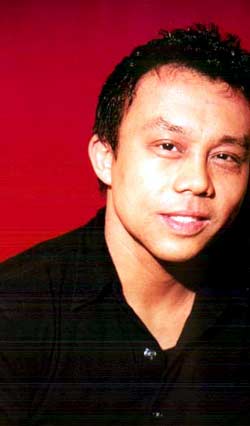
In his search for truth, identity, and a sense of belonging, Ron Domingo speaks from the heart. His passion is evident not only in his work as a consummate theater actor but also in his freshman attempt at filmmaking. Anniversary, his six-minute narrative short was chosen from a group of 400 entries to be featured as one of the 130 selections showcased at the San Francisco International Asian American Film Festival in March 2003 (visit the NAATA site for information on the festival).
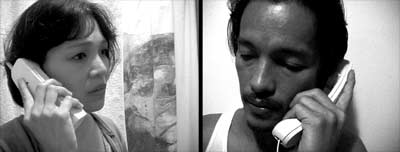
Domingo is an actor's director who paints a riveting portrait of intensity in black and white and elicits an honest desperation from Art Acuna and compassion from Lydia Gaston in this story, which centers on a surprise anniversary phone call to an ex-lover. NAATA festival director Chi-Hui Yang said, "Anniversary is well crafted. The committee selected Anniversary to screen at the San Francisco International Asian American Film Festival because it has a winning combination of good dialogue and action, along with the sensitive direction of the actors creating a rawness and fragility of human relations." AsianConnections' Arts and Entertainment editor Lia Chang caught up with fellow thespian Ron Domingo on his latest projects during a break between takes of portraying a Tibetan restaurant owner on an episode of Law and Order SVU. Lia and Ron acted together in Jeff Weiss' Obie award winning late night theater soap opera Hot Keys in the late '90's off Broadway. They chatted about making Anniversary, his directorial debut shot on digital video, navigating his career as an actor in New York, and his rite of passage as part of the terrific ensemble of playwright Lonnie Carter's The Romance of Magno Rubio based on a short story by Carlos Bulosan, produced by Ma-Yi Theater in November 2002. A graduate of IFP New York's film mentorship program Project Involve and Third World Newsreel's Film and Video Production Workshop, he and best friend fellow actor Ken Leung partnered and formed their own production company Fish Out of Water where they produce, write and direct their own films. Lia: What was your filmmaking process for Anniversary? Ron: The process was born out of an experimental exercise with some actor friends a few months earlier. I came up with a project idea and gathered friends with digital cameras to create a short film. I see many talented Asian American actors that don't get enough opportunities, so I invited a few friends to my apartment and started creating our own work. What excited me was that we were able to make a short in one day. I then applied to the International School for Film and Television in Maine, which had a great DV production program for a better understanding of the production side. And to apply for the program, I needed an example of my work. Based on my friend, Phil Rectra's idea, I started writing a treatment. I ended up writing just one scene. Lia: How did you work with your actors? Ron: I gave my actors Art Acuna and Lydia Gaston the script and rehearsed with them. It was all done in one day. I provided them with the sketched out idea and the actual dialogue of the script that became the film. We met and I had the camera and let them improvise. I tried to build history between them-actory stuff-like improvising this is your first date; this is where you met, all that kind of stuff. Fast-forward five years - exploring the present state of their relationship, and the last scene was what we were going to shoot - this telephone conversation. I encouraged them to loosen it up and to improvise and play with the circumstances. They were actually talking to each other at the same time. This takes place in my apartment -- Lydia is in the bathroom and Art's in my kitchen. I had two phone lines. I wanted them to have a real conversation so that the performances would be true. They did such a great job. I had a clear idea of the story that I wanted to tell and my editor transformed the footage to the finished product that night. It was due Friday and I shot it Thursday. He edited it that night.
Lia: I found Anniversary to be an intimate and very real experience.How did you achieve that? Ron: This was my first film. My talented editor Steve Mallorca put it together; he made the film what it is. He's also a filmmaker. I've acted in his films, and will be acting in his film, Slow Jam King this spring. The thing I loved about this-it felt like a theatrical experience. It's not very cinematic at all. It's very theatrical, due to my background as an actor. It's such a collaborative experience. Having directed it, it's hard for me to say that it is my film. Every aspect of it was collaborative. Roxanne Baisas was my assistant director who did the camera for Lydia while I did the camera for Art. Sure I wrote the scene, but it was with the help of friends. It's like theater where we try and experiment. My personal experience acting in films has always been to learn your lines, show up on the set and just do them. I didn't want that kind of film experience. I can make my own films and I want to make it as collaborative and fun for all of us. It was such a labor of love; it will always have a special place. Lia: What was the New York Asian American International Film Festival like? Ron: Steve mentioned my footage was pretty good and that I should consider entering it in some festivals. I sent a rough cut to the Asian American International Film Festival. After it got accepted, we did all the final cuts and edits. It was exciting to have the film screened at the Asia Society in July 2002 as part of the festival. I thought that would be the end of that process - to go to the film festival and screen it. Instead, David Maquiling, one of the AAIFF festival directors, was generous enough to include Anniversary in the Anthology Film Archives NewAsianFilmmakers Series. It screened with four other Asian American shorts that were some of my favorites at the festival. It was an honor to be in the company of such talented filmmakers, some of whom I've worked with as an actor. After that I entered it in the San Francisco Asian American International Film Festival. When it was accepted, I was thrilled.
Lia: Why did you choose Art Acuna and Lydia Gaston for your film? Ron: Besides considering them friends, I've always thought highly of their work and I wanted to give other Filipino actors opportunities. I needed actors who were talented, that would be able to deal with my process because I was so green. They made me feel safe. There are enough things that can go wrong. You want to control what you can control and casting is a major consideration. You don't want to have to deal with lots of problems on your first film. I couldn't have asked for a more talented cast. Lia: Where did you grow up? Ron: I was born in Brooklyn, New York. Then moved to Edison, New Jersey, Potsdam, New York and eventually settled in Staten Island, NY. I graduated from Xavier High School in Manhattan and went on to Boston College. Lia: Were there many other Asians in your neighborhood? Ron: We were the Asians. I was lucky enough to live on a block with two other Filipino families. They were like my brothers and sisters. I had an upper middle class upbringing because my father was a doctor. We never really experienced a lot of racism, but I never quite felt at home. I never quite felt American. Lia: You were born in Brooklyn. Why didn't you feel American? Ron: I wasn't aware of race issues until after college where people started telling me, 'no you are this, this is what you are'. My ethnicity became a problem once I pursued acting. My acting teacher told me she didn't know what scene to give me. She suggested Teahouse of the August Moon since Marlon Brando played an Asian in it and suggested I take a look at that. In my search for roles to play, I came across David Henry Hwang's FOB, and as much as I loved it, the story was Chinese. I'm Filipino and I felt like I didn't quite belong. I had been out of college for five years and I went to the Phillipines to find my roots in 1995. Lia: What was your experience like when you went to the Phillipines? Ron: I went back to the Phillipines in search of my identity. It took going to the Phillipines and learning from the Filipino people that I was American. I went over there and realized that I was not Filipino. Some made it very clear. So I said if I don't feel at home in America, I better make it my home. I came back home and changed my lifestyle. I came back with a whole new perspective. I realized if I wanted a home, I needed to start building it. My home is in the United States because I am an American. It was an empowering visit. Lia: How did you change your lifestyle? Ron: I stopped bitching and I started doing. Before I used to question why there weren't any roles for Filipino actors. WHY? I realized it was because there weren't many Filipino people here in America writing them. Of course, many of us are familiar with Carlos Bulosan, but not many others. Why should people of other races write something about the Filipino American experience when they don't know it? It's my responsibility to write about them. I decided to explore that and start working on things, doing my own projects. I honestly believe that this business is like any other business. It doesn't matter whether I am brown, or Filipino, or green. If you have something that sells, they'll hop on the bandwagon. Lia: What inspires you? Ron: I saw so many talented friends of mine. My best friend and collaborator, Ken Leung and I went to see a Ma-Yi play called Middle Finger. Ma-Yi produces such quality work and after seeing the show I was so inspired. I wanted to get all of my Asian friends together and put them in a movie. I had filmmaker friends because I had worked with filmmakers when I first started out acting in some scenes at The Workshop, a collaborative group of Asian American filmmakers. There I met filmmakers like Greg Pak, Mike Kang, Francisco Aliwalas, Tom Moon, just to name a few and I believe they are on their way to making some great feature films. This Asian American filmmakers movement is starting to happen. We are making opportunities for ourselves. This is what inspires me and keeps me going. Lia: What are some of your other interests? Ron: Well, I was a musician before I became an actor. I was a real band geek in high school. I played clarinet, keyboards, saxophone and sang. Later on in college, I really had a passion for Jazz. Lia: What was your major at Boston College? Ron: I was a bio major. I was supposed to be a doctor. I was pre-med. I was a bio major up until junior year simply because I didn't know what else to declare. Then I realized I didn't want to be a bio major, I wanted to change. I chose psychology since I had all the prerequisites. I just wanted to graduate. Academics were not my favorite part of college at all. It did allow me to explore the arts. But it wasn't an art school, but for some reason, the arts really flourished during my time there. I don't think I would have had the courage if it were an arts school. Since I could sing and I could move, my first show was West Side Story. I wanted to audition for the role of Tony, but being at Boston College, if you are any kind of dark, you were cast as a shark. I had not considered the race issue. I didn't realize. I was told that I couldn't. I said I love 'Tonight, Tonight' - I want to sing that part. I was told no, you are not going to get cast as Tony. Lia: What is the national commercial you have running now? Ron: After twelve years of acting I got my first national commercial, a Wendy's commercial. And in my first episode of Law and Order, I played a crime scene unit detective. It was great. I made a breakthrough in terms of my career because I had never been on camera before. And so far, I haven't had to do any accents. Lia: Who are the other actors that you worked with on the show? Ron: I had a scene with Jesse Martin and Jerry Orbach and they were fantastic. I was so nervous. I had my lines down cold, but when I got on the set to run lines with them, I kept messing up. It serves me right. I was trying to come off like this professional who had been doing this for so long and ended up stuttering through the line thru. Minutes before I called Ken who was on location shooting a film and started running lines with him. I had them cold, blah, blah, blah. But thank God when it came time to shoot, things went well.
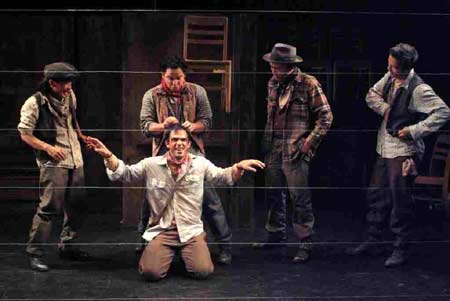
Lia: In the Fall of 2002, I saw you in a jewel of a play based on Carlos Bulosan's short story about Filipino migrant farm workers in depression era California, Lonnie Carter's The Romance of Magno Rubio, produced by the Ma-Yi Theatre Company in New York. Can you tell me about this magical theatrical experience? Ron: Working on Magno Rubio was amazing because I got to work with four other Filipino actors -- Orlando Pabotoy, Ramon de Ocampo, Art Acuna and Jojo Gonzales -- that I've admired throughout the years. There are a lot of people who don't know who Carlos Bulosan is. Being in the arts, I was already familiar with him. When I came into the production, I had done research on these migrant farm workers. What I'm realizing is that a lot of people don't know our history. Lia: In your research for the play, what did you discover about the Filipino experience in the 30's? Ron: The thing that excited me the most was understanding that this was a rite of passage for these men. My father came over in the 60's when they had the shortage of doctors and nurses. When you are a doctor, you are well respected in the community, so we never really had much trouble growing up. And yet I still felt like I didn't belong. I believe it's because I never had to experience this rite of passage. These guys had to really suffer. This is my birth rite. I belong in this country because of these men. They've paid my dues. Every minority group went through it. I just never knew Filipinos went through it. When these books started coming out. I started realizing after reading Bulosan what they went through. I loved the fact that these guys were slicksters and white women were attracted to them because they were slick and dressed really nice. And would spend all of their money in taxi halls. I would love to have seen these farm workers transform into these slick guys dancing. But regardless, they were farm workers, the lowest of the low. And Americans hated them for taking jobs. Americans hated them for f**king their women. They thought of them as monkeys so they wanted to keep the Filipinos out. Lia: Why did Magno Rubio become a personal rite of passage for you? Ron: There are a lot of young Filipinos going through the same things I went through as a kid -- not feeling like they necessarily belong. It has everything to do with me. If I feel that I belong in this country, that I can make a positive contribution. Then I belong. Then I have an identity. I am a full-blown American. And stories like Magno Rubio, empower you even more. This play is a gift to the Filipino community, the Asian community. People need to know about it because it will help them through. The play takes place around the time of Steinbeck's Grapes of Wrath. It's a very American story that has never been told. That is what was great about acting in Magno Rubio. To be a Filipino and have the story be Filipino specific, I didn't have to change a thing. Everybody in Ma-Yi collaborated to create and tell a story that many people are not familiar with. The hardship and the suffering these immigrant migrant farm workers went through made me proud to tell their story. These guys went through a lot of crap, the racism was incredible and they were treated like any other immigrant group that was poor. For Filipino Americans, this is our rite of passage. This is what gives us permission as Filipino Americans to stand here and say these are the dues that have been paid. Normally most Americans that are a few generations away from their own immigrant roots forget that what they own now and feel such strong ownership over what was earned by people just like the ones they mock and tease. I'm just a little closer to it because of my immigrant parents. Lia: What kind of stories would you like to explore through your filmmaking? Ron: I have a problem with not seeing any Asian American men having sex on film. It seems that we're not viewed as sexual beings. As for other stereotypes and the way Asians have been portrayed in cinema or television, I'm not denying that there is truth to them or ignoring the fact that they exist, but its very one-sided. It is a non-Asian perspective. I'm interested in showing the other side. Only I can. I want to show them that these immigrants have thoughts, cares, and work as hard as they can to make the best of their lives. It's amazing what my parents had to go through to leave their family and their country, to come here to make it, and send money to their families so they could survive. It's just amazes me. How they form their own families and communities. Lia: Where do you see yourself going forward professionally? Ron: Right now, I'm really passionate about the filmmaking process, but I still love to act. I've dedicated a lot of time and love to the craft of acting. Being an actor can be tough. I'd like to see more roles out there that are well rounded. Like most of us, I'd like to see the more human side of Asian characters . For instance, in Greg Pak's Robot Stories, currently in competition at the 2003 Slamdance Film Festival, I play Sab Shimono's son. Greg is an amazing filmmaker. Since he wanted me for the role, and Sab is Japanese, he cast an African American woman to play my mother so that it would work visually. I thought, 'who would do this'? To his credit, he has that kind of vision and commitment. That started production September 10, 2001 and he worked through the entire crisis. He's just so talented, dedicated and hard working. The man knows what he's doing. I'm proud to be in the film. Greg and I have had discussions and we've talked about not wanting to focus necessarily on Asian centric issues, but on human issues involving people who just so happen to be Asian � Ultimately, we just want to tell good stories. Ron Domingo Theater credits include: Cleveland Playhouse, Lincoln Center, Ma-Yi, NATCO, New York Theater Workshop, Pan Asian Repertory, Public Theater, Vineyard Theater, and the WPA Theater. Also the Obie Award winning Hot Keys and Richard III with Austin Pendleton. Film & TV: Law & Order, Robot Stories, Law & Order: SVU, Avenue of the Asian Americas, Barrio Fiesta. Commercial: Wendy's, MTV. Ron received an Off-Off Broadway Review Award for his performance in A Private Recital at the Turnip Festival Theatre. |
||||||
|
|



 AsianConnections
Arts & Entertainment Editor Lia Chang (left) currently appears as
Nurse Lia on As The World Turns and One Life to Live.
Based in New York, she works as an actor, a photographer, a multimedia-journalist
and designs greeting cards. Lia and Ron acted together in Jeff Weiss'
Obie award winning late night theater soap opera Hot Keys in the
late '90's off Broadway. AsianConnections wishes to thank them for
their generous time and efforts in making this interview possible.
For more on Lia, visit her website at
AsianConnections
Arts & Entertainment Editor Lia Chang (left) currently appears as
Nurse Lia on As The World Turns and One Life to Live.
Based in New York, she works as an actor, a photographer, a multimedia-journalist
and designs greeting cards. Lia and Ron acted together in Jeff Weiss'
Obie award winning late night theater soap opera Hot Keys in the
late '90's off Broadway. AsianConnections wishes to thank them for
their generous time and efforts in making this interview possible.
For more on Lia, visit her website at  |
|||
|
 |
|
|
| | About Us | Disclaimers and Legal Information | Advertise With Us | We welcome your comments. Send e-mail to us at info@asianconnections.com Copyright ©1999-2002 AsianConnections.com |