|
| |
|

| ||||||||||||||||||||||||||||||||||
|
|
|
||||||||||||||||||||||||||||||||
|
AC Team interviews the stars
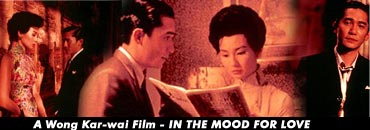
These two characters first meet while moving into rooms in apartments directly next door to each other in a small crowded apartment in Hong Kong in 1962. Chow's wife is in Japan on business, as is, ironically, Su's husband. Su and her husband, and Chow and his wife each rent literally one room in an apartment and must share their kitchen and living space with another couple. These two older couples enjoy loud jovial dinners and games, and live in a communal world that sharply contrasts with Chow's and Su's quieter and individually alienated existences. While neither Chow's wife nor Su's husband are ever seen, their presence hangs over the film with an oppressive force that hinders both Chow and Su from experiencing any sort of peace or fulfillment. This shared betrayal eventually brings Chow and Su together, as each yearns for the other to make sense of the circumstances and of their lives. Alone, Chow and Su wander through the streets of Hong Kong and the cramped hallways of their building like lost wounded animals, unable to take part in their world.
Chow and Su share a secret in their knowledge of their mates' affair and in their relationship with each other. However, while their neighbors remain unsuspecting of the duplicity of Chow�s wife and Su's husband, they display suspicion of the agonizingly innocent relationship between Chow and Su. Neither Chow nor Su manages to invoke a step towards passion or love within their friendship, but use the platonic relationship to move forward in their understanding of their own lives. Su helps Chow write a martial-arts story and Chow acts as a stand-in for Su's husband while Su rehearses how she will confront him upon his return. Ultimately, this very innocent, tenuous and hesitant relationship remains unconsumated and each character moves forward with his or her life with the aching memory of what never was. Wong Kar-wai beautifully recreates 1962 Hong Kong with elegant dresses filled with all the shameless bright colors of the early 60's and a medley of American songs, including Nat King Cole's rendition of "Perhaps, Perhaps, Perhaps." However, one of the biggest treats of the soundtrack is the mysterious, edgy and stylized music created by Michael Galasso. The violin sounds work to create a sense of tension and suspense that one might associate with a detective story. However, in this film the music assists in highlighting the mystery of Chow's and Su's very ambiguous relationship.
AC Team's Solange Castro Belcher moved to Hollywood to pursue a career as a stand-up comic after graduating from Yale University with a degree in English. Today she has turned her pursuits from comedy to film reviewing and screenwriting. Solange is managing editor at University of California at Los Angeles' groundbreaking Teaching to Change LA, an online journal for teachers, students and parents in the Los Angeles schools. In addition to her film reviews for AsianConnections.com, and AC's Hollywood site StudioLA.com, she is a contributing film reviewer for the Santa Monica Film Festival (smff.com). Email: solange@asianconnections.com --------------------
| ||||||||||||||||||||||||||||||||||
| ||||||||||||||||||||||||||||||||||