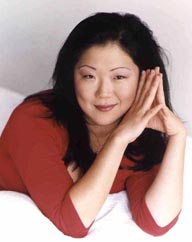
Margaret
Cho
Comedian
She's
Performing to Sold-Out -- Audiences Across the U.S.
Margaret Cho's
new autobiographical movie "I'm The One I Want" is debuting across
the country.
Click here
for details!
Get
ready to relish the Fresh, the Fun, and the Fearless standup and
television/movie performer Margaret Cho. AsianConnections caught
up with this brash young comedienne just before she flew east from
California, and into then Hurricane Bonnie, to appear at sold-out
performances in Texas.
The
image of this fresh young Asian talent, headed storm-ward for the
sake of the show, seemed strangely fitting. "I think it's fortunate
that I am so fearless," Cho noted during our interview.
"Also
it is sometimes unfortunate because I have made a lot of mistakes."
Mistakes or no, we're glad she's so fearless, too. It's brought
us that many more chances to see her in action.
Perhaps
you're most familiar with Cho from her starring turn as Margaret
Kim of ABC's sitcom "All American Girl".
Or
you might have enjoyed Margaret in the movie "Face-Off"
or as a recurrent presence on Comedy Central specials, most recently
the series "Pulp Comics" (following phenomenally popular
"South Park"). Then again, you may have seen Margaret
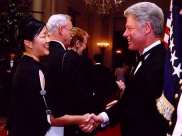
in photos with President Clinton at the White House or with the
president of Korea.
But
wherever you've seen her, however you know her, you don't forget
her. She's that kind of unique.
Margaret's
career from the start let her rub elbows with great names in comedy.
When barely 20, Cho entered a collegiate competition where the prize
was getting to open for Jerry Seinfeld. Even though she didn't win,
Jerry gave her some strong mentoring advice. "He was very direct,"
says Margaret, and "very honest". He urged her to persevere
in her efforts.
"He
told me not to be discouraged by coming in second, that the real
wins would come later in my career. He really encouraged me to just
go for it and go be a comedian." That she did. Today, Cho is
the sole Korean-American, female member of a typically white male
institution, the Friar's Club headed by legendary Milton Berle.
"To be included in that really exclusive fraternity, I guess,
is somewhat of an honor," acknowledges Cho. She's also been
tapped to do her first roast-- Drew Carey in October in New York.
Her
upbringing in a traditional patriarchal Korean immigrant family
seems to belie her own nontraditional pursuits. "Here I am,
"says Margaret, with great success in a career that is typically
characterized as unfeminine, unseemly and oftentimes crude.
"Not
only am I absolutely unafraid to talk about any aspect of my life,
I really challenge all of those traditional values, so it makes
perfect sense to me that people would oppose what I do just by virtue
of what they have had ingrained in them from society, and that's
fine, because their dissent is proof that I'm right." Yet that
same tradition-oriented family supports Margaret and the options
opened to her in their new chosen homeland .
"They
are really happy, really pleased." says Margaret, "Because
America, this country that they immigrated to, accepted their child
in a place that they never thought that they would see Korean faces.
That for them is a great achievement and also such a comforting
thought."
For
Margaret, the difference between stand-up comedy and acting in movies
or television is more than the exhilaration of giving everything
you have before a live audience. On the road, there's also a real
feeling of ownership of the material as well as a lack of censorship
that makes each performance particularly electric.
The editorial control
possible with stand-up, unfortunately, was missing when it came to
Cho's subsequent experience with TV's "All American Girl".
With its debut in 1994, "All American Girl" was heralded
as a groundbreaking effortand, as the first Korean American to star
in her own series, Margaret heralded as it's real life pioneer. At
the same time, however, some Asian press were notably critical of
the show. Says Cho, "I accept that criticism as being absolutely
true." For example, some were critical that not all the actors
were of Korean descent on a show about Korean-Americans. Yet from
a practical standpoint, relates Cho: "There were simply not any
Korean-American actors to be found, an unfortunate fact of the entertainment
industry."
And
what the press failed to understand, she continues, was that this
type of trivial criticism obscured the real issues. Cho has come
to realize that the show's problems were writing, including her
own lack of editorial control, as well as its emphasis on an ethnic
portrayal of her Korean-American family.
This
portrayal painted the family as too different in fundamental ways
from the typical American family with everyday problems and situations.
Cho describes the "It must be ethnic!" dictate as "racism
under the guise of sensitivity, and just as insidious." She
elaborates, "My question is why is ethnic different? Why can't
ethnic be somehow similar? They did us a disservice, because we
were always trying to speak that ethnic voice, but that ethnic voice
doesn't really exist because it's too theoretical."
Had
"All American Girl" been allowed to develop using everyday
problems and circumstances, more along the lines of shows like "The
Jeffersons" or "The Cosby Show", the outcome could
have been different. "I had a lot of power usurped from me
in different ways," she explains.
For
example, she says,"When I started complaining about the show,
an executive came back and started talking to me about my weight.
They provided pay for a trainer, pay for a nutritional analysisall
this stuff to divert my attention."
Even
so, the network was not the sole source of problems with the show.
"I didn't understand myself as a performer as well as I do
now, certainly," Cho acknowledges. "All of it had to do
with the fact that I wasn't ready, because if I had been ready,
I would have known and understood that they were trying to divert
my attention."
Having
survived her first sitcom, Cho is ready to attack television again
from a completely different angle and looks forward to that occurring
in the near future. She's now teamed with a comedy partner, Karen
Kilgariff, to write and star in an original show. Not really a sitcom
or quite like anything that's been on television before, she calls
it "very new" and "very basic."
We're
intrigued and can't wait for a closer look. Another recent Cho project
will keep her on her feet as a dancer in the comedic movie "Triple
Threat". Cho has some closing advice for Asian-Americans, and
particularly those bright new Korean-American faces, looking to
break into the entertainment industry. "We haven't been out
there long enough. We're the first generation to be really establishing
ourselves," Margaret concludes. "I failed [with All American
Girl] only because I didn't believe that I could win in the first
place."
"I
welcome [other Asian Americans] with open arms. We need the voices
out there... You've got to persevere, you've got to trust your instincts
and really believe in what you can do. Don't be discouraged by the
lack of Asian faces out there, because yours could be one. Yours
could be one- -yours should be one and we need you." Well said,
Margaret, and we need you, too still fresh, ever fun, and fantastically
fearless!
-
by AC Team Cherie Campbell, Greg Karns, Michael Kai and Suzanne
Kai
--------------------
More on Margaret's TV, film and personal appearances click
here for her 2000 schedule.
Send fan mail to Margaret
Cho through AsianConnections.Com
More about Margaret
Cho:
AC
Team Interviews the Real Margaret Cho Summer 2000
Margaret's
Movie - "I'm The One I Want"
|