Image courtesy Barry Lee Brisco, WomenAsia.com
 By
Rosemary Brisco
By
Rosemary Brisco
AC thanks Rosemary Brisco, CEO and Founder of the award winning
WomenAsia.com for this excellent article.
Women are
being drawn to the Net in increasing numbers,
in part because of the unique characteristics of online life;
the power of e-mail, the ease of establishing relationships, and
the lack of gender judgements in the anonymity of cyberspace.
There is no
question that women are a growing percentage of the online audience.
When the first commercial Web browser was launched in late 1994,
the vast majority of Net users were male--only five percent were
females. By the end of 1998 in the U.S. - a mere four years later,
women were 48 percent of the total online population, closely
mirroring the male/female ratio in the general population.
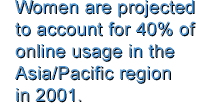 Asian women are riding in on this wave. Women are projected
to account for 40% of online usage in the Asia/Pacific region
in 2001.In China 15% of Net users are female, in Japan they account
for 39% of new Net users, and female net users in Singapore are
ubiquitous.
Asian women are riding in on this wave. Women are projected
to account for 40% of online usage in the Asia/Pacific region
in 2001.In China 15% of Net users are female, in Japan they account
for 39% of new Net users, and female net users in Singapore are
ubiquitous.
The reasons
for this transformation are many. In part it is due to the Net
transitioning from requiring impossible-to-remember commands embedded
in obscure interfaces, to the point-and-click ease of the Web.
But this has drawn men and women alike; everyone appreciates ease-of-use.
Words are Power
Despite the rise
of the Web, e-mail is the most heavily used Internet application.
By its very nature, e-mail is gender-neutral; your words, and
the ideas they express, stand or fall on their own merits. You
may be a short, slight female with a quiet voice who might have
trouble making an impact in a room full of ego-driven males, but
on an e-mail discussion list everyone is equal. This automatically
places women on an equal level with the men no matter how many
exclamation points they use! No one can interrupt you in mid-sentence,
or worse, claim credit for ideas you propose; your thoughts and
ideas are documented for all to see.
Women are beginning
to appreciate these advantages. In Japan, a Nikkei Market Access
survey showed that the number of women who are planning to purchase
a PC is growing, and that 81 percent of first-time women PC buyers
cited use of e-mail as the main reason for their purchase.
Net Networking
Gender stereotypes
aside, women are natural networkers and the Net is a powerful
facilitator. The number of women-only online support groups and
e-mail lists for female entrepreneurs and business leaders has
mushroomed.
One of these,
The Forum for Women Entrepreneurs (in California), is in such
demand that it restricts its membership to proven entrepreneurs.
Their e-mail list is a bubbling brew of ideas, support, and mutual
hand-holding that can help propel a fledgling startup to IPO status.
Open to all, SFWOW (San Francisco Women on the Web, at www.sfwow.org)
offers an e-mail discussion list, meetings and workshops, and
a peer mentoring program for members to guide each other in enhancing
their business and technology skills. Though it started in New
York, Webgrrls International has expanded into Asia with sites
targeted at Hong Kong, China and Japan. The online organization
provides a forum for women to network, exchange job and business
leads, form strategic alliances, mentor and teach, and learn the
skills to help them succeed in an increasingly technical workplace
(www.webgrrls.com).
Web sites can
be designed to build relationships, a powerful motivator for women.
As Bernadette Tracey said in a recent Advertising Age piece, "Men
focus on transactions while women thrive on making personal contacts."
Sites can offer customized navigation, purchasing incentives,
and discussion groups, all features that, according to a recent
NetSmart survey, are desired by women more than men.
Still, language
remains a barrier. Most sites are only offered in English, and
this tends to exclude all but the highly-educated Asian businesswomen.
The Nature of
Work
The Internet
is just one part of a broad trend in industrialized countries
that are moving to a post-industrial economy; the nature of work
is changing from requiring physical labor to demanding the intellectual
capability to process information, an arena where educated women
suffer no comparative disadvantage to men.
In The Sound
of the Virtual Voice, Esther Dyson writes that "...the
Internet is tailor-made to help women finally find their voices."
She points out that for those women who feel stifled in corporate
environments, the explosion of entrepreneurship online offers
a wealth of opportunity to business-minded women that did not
exist just a decade ago.
From Tiananmen
Square to Harvard Square
An example of
how Asian women are transforming themselves through the Internet
can be found in former Tiananmen Square student leader Ling Chai.
Ten years ago she helped lead the student protests that led to
the violent government reaction in Beijing. To escape from Chinese
authorities, she spent five days nailed inside a shipping crate
on its way to Hong Kong. She later arrived in America speaking
no English and with few resources, but after earning degrees from
Princeton and Harvard she has made the switch from political protestor
to Net entrepreneur. She helped found www.Jenzabar.com,
an intranet product targeted at educational institutions.
Such opportunities
are still some ways off for many Asian businesswomen. In Japan,
women are CEOs of only about 5 percent of all Japanese companies,
and many of the firms they head are smaller, family-type enterprises.
According to a recent Japanese Labor Ministry survey, many companies
do not offer women positions in management because of "lack
of knowledge and judgement". This may gradually change as
new government laws on equal hiring and promotion go into effect.
But in other Asian
countries, online entrepreneurs are striking out on their own.
In Singapore, Cheryl Ng launched Style Surfers, an unconventional
and refreshing online alternative to the women's fashion publishing
industry. The site is a mix of fashion, Women's Issues, relationships,
arts, travel, health and food articles, drawing on Chinese, Malay,
Indian, and Caucasian writers. Ng says "We are starting to
see the birth of a paperless society, and starting an online business
is in line with this trend as well as being very economically
viable for entrepreneurs like myself" (www.stylesurfers.com.sg).
But women are
still slotted into traditional roles online. On the SingNet portal
page (Singapore's first Internet provider) the only mention of
women is a section titled "Women Now", which consists
of three links to major online stores, giving the impression that
all women want to do on the Net is shop.
Women's Groups
Gain Online Exposure
With web publishing
becoming increasingly accessible, women's organizations in areas
as remote as Mongolia, Vietnam and Nepal can find a voice on the
Net. The Mongolian Federation of Business and Professional Women,
ASMITA Magazine in Nepal, and the Viet Nam Professional and Businesswomen's
Network have all found a home under the auspices of this site,
WomenAsia.com. Our database powers a growing community of female
professionals and businesswomen and allows, for example, a Canadian
company seeking a textile manufacturer in China can research potential
partners in seconds.
The Asian Women's
Resource Exchange, based in Japan, is a Web-based women's information
service and network. It is geared towards developing cooperative
approaches and partnerships in increasing access and exploring
applications of new information and communication technologies
for women (www.jca.apc.org).
Ultimately,
the Internet is all about making connections, and with the e-mail/Web
explosion those connections are multiplying at an exponential
rate. One can readily imagine a future where it will no longer
be remarkable to find Mongolian women online, or Chinese dissidents
founding Internet startups; it will just be business as usual.
==========
Rosemary Brisco has a background of 16 years of sales and marketing
experience in Canada, Singapore and the U.S., encompassing printing,
publishing and the Internet, and is the Founder and CEO of WomenAsia.com,
Asia's first business to business networking website connecting
women in Asia and North America. The site serves a growing community
of women who want to connect with one another for business and
trade purposes.
Copyright WomenAsia.com, LLC