Ads used to be here |
 |
 |
 |
 |
 |
 |
 |
 |
 |
|
|

 |
|
|

| Entertainment |
| Stars |
|
Raining
in My Heart
by
Ben Fong-Torres
AsianConnections is proud to present the adventures of Ben Fong-Torres, our Renaissance man: author, broadcaster, and former senior editor and writer at Rolling Stone Magazine. This guy's our hero! Ben
was a featured character in "Almost Famous," the Oscar and
Golden Globe-winning film by Cameron Crowe.
I saw Dan Rather
break down and cry---twice---on Letterman the other night. After
the first time, he apologized, saying he was supposed to be a "pro,"
paid to not cry. Not that we haven't been doing enough wiping of our own eyes. As another song goes, let it rain. (related story - click here for Amy Tan at Ground Zero) PLANET OF THE APAS: Congratulations to the AAJA (Asian American Journalists Association) on a great 20th convention in San Francisco. About 1,000 reporters and broadcasters gathered for several days and nights of panels, speeches, workshops, mentoring sessions, award banquets, and, of course, partying and schmoozing. They've done this before -- 13 times, in fact, in various cities where the 1,700 member group has chapters (last year, New York; next: Dallas). But this year, I noticed a shift. The AAJA has gotten young. Maybe it was just me, I thought, but, checking with a few fellow attendees, I found general agreement. On stage and on the dance floor at the post-banquet karaoke party (which I emceed), and all around the Hyatt, it was obvious-and encouraging. For better reporting on racial and community issues, and for the media to best reflect their audiences, we've got to have more minority representation than we do now. To see so much youth-whether at the AAJA-sponsored Boot Camp By the Bay at USF (which I had the pleasure of keynoting) or at any number of convention events-was to see a brighter future. I also had fun being part of an authors reception, with about a dozen AAJA members who've published books, among them Bill Wong (Yellow Journalist), Phoebe Eng (Warrior Lessons), Emil Guillermo (Amok), Cynthia Chin Lee (A is for Asia), Fred Katayama (Japan: A Living Portrait), Jeff Yang, publisher of A. and author of My Name is Jackie Chan, Dalton Tanonaka, in from Hong Kong and happy to offer three books, including Dateline Tanonaka. It was also good to see, again, Helen Zia (Asian American Dreams), whose upcoming book with Wen Ho Lee has been and will be hot news. Thanks to Rosy Chu of KTVU (the Fox station for Oakland-SF), who MC'd the gathering; to Helen, who organized it; to Lisa Chung of the San Jose Mercury, who got me to handle the hordes at the karaoke bash; to Culture Shock, a phat hip-hop dance troupe that got the crowd rocking that night, and to Denise Castaneda, who organized the karaoke and two other convention events, and worked 24/7. But, hey, she's young. FARE THEE
WELL:
Mimi Farina got the sendoff she deserved the other morning at Grace Cathedral on Nob Hill in San Francisco. More than a thousand friends, family, and people who benefited from her work jammed the beautiful church to say farewell with music and stories, sung and said by Boz Scaggs, Judy Collins, Jackson Browne, Holly Near, Maria Muldaur, the Oakland Interfaith Choir, and Joan Baez, Mimi's older sister. As Boz said,
Mimi reminded popular artists that they had been gifted, and that
they should give back to their community. Mimi was the guiding force
behind Bread & Roses, which provides musicians and other
entertainers for free shows at institutions throughout Northern
California-hospitals, senior centers, prisons, brightening untold
thousands of lives over 20 years. Mimi began as
a singer, guitarist, and dancer, and recorded two albums with her
late husband, the novelist Richard Farina. But she truly found her
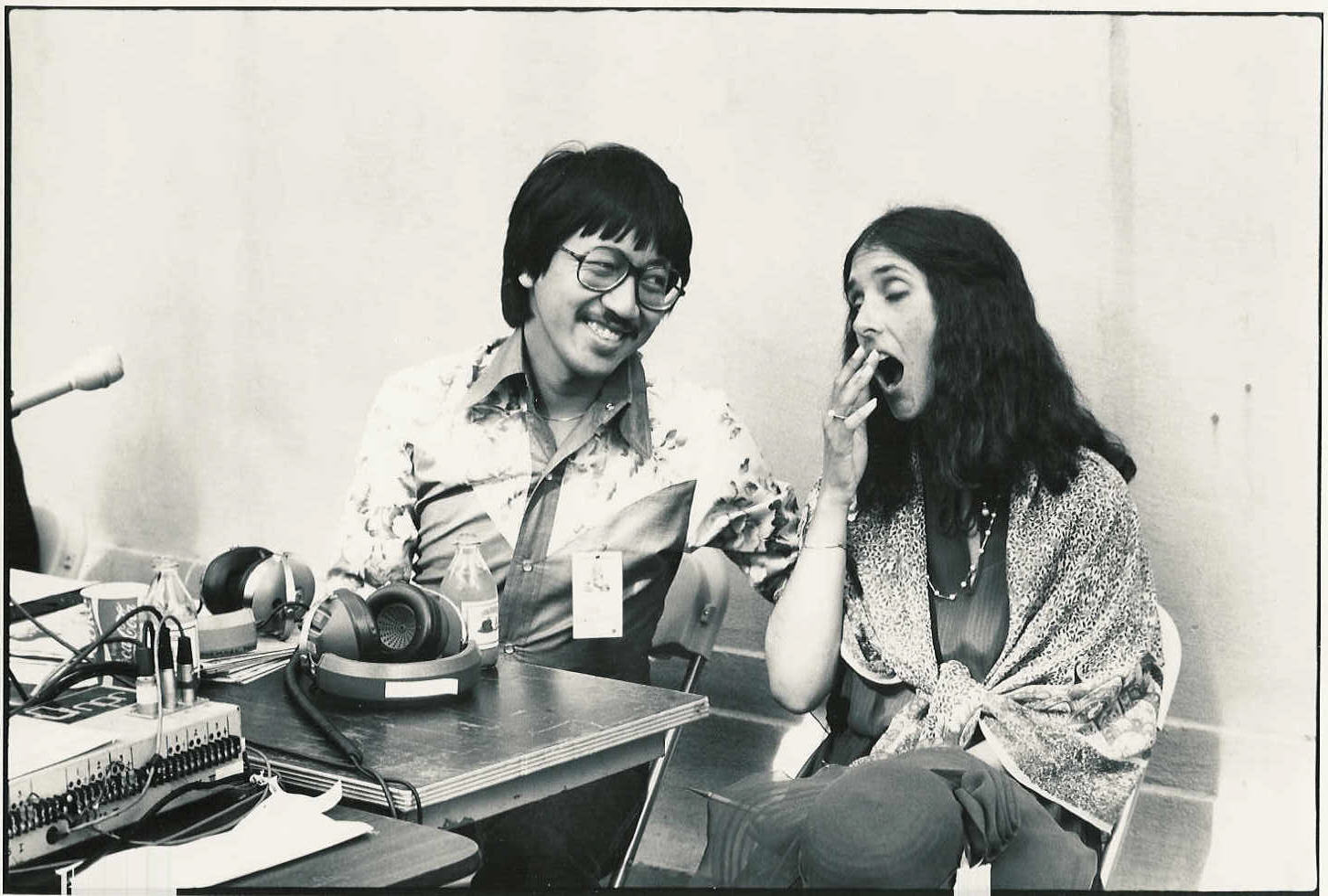
life's calling with Bread & Roses, and I had One year, I hosted a live broadcast of the festival for NPR, and Mimi dropped by to our backstage studio for an interview. As you can see, she was mesmerized by my questions. Beauty, music, laughter, love, life-that was Mimi Farina. RANDOM NOTES: Good going,
Connie Chung. You did us proud, going after Gary Condit the way
you did. It was next to impossible to get him to depart from his
tight, scripted responses, but Chung never stopped trying. Just
as the ABC Primetime session was a textbook for how
disgraced public figures should not do an interview, it's a lesson
for journalists on not giving up.
Almost Famous?
There comes
a point when I just want to give up and relinquish the tape recorder
to my interviewee, that point being the beginning. After all, this
is the Ben Fong-Torres, the famous Rolling Stone editor
portrayed in Cameron Crowe's autobiographical Almost Famous.
He's been doing this sort of business longer and better than I have,
mingling with music and film legends And I just interviewed him. Professionals have interviewed this man; he even graced the cover of BAM Magazine, the famous Bay area music publication. He has one of the most recognizable bylines in the music industry, though that may also be partially caused by his unique name. (Fong-Torres is full Chinese. Because Chinese immigration was previously restricted, his father purchased the name "Torres" so that he could enter the United States by declaring himself to be Filipino.) In 1973, Fong-Torres discovered the then 15-year-old Crowe, who would become the youngest Rolling Stone reporter ever. He later turned to movies, writing Fast Times at Ridgemont High and, more recently, writing and directing Jerry Maguire and Almost Famous. Fong-Torres met the precocious Crowe at a Rolling Stones concert. In the foreword of Fong-Torres' anthology of interviews, Not Fade Away, Crowe writes, "I read your articles in Rolling Stone, not even realizing you were responsible for assigning and shaping all the other music profiles too. I wanted to interview Crosby, Stills, Nash & Young. I wanted to be you?The Rolling Stones were now taking the stage. Mick Jagger ripped into 'Oh Carol,' but all I was thinking was I just got an assignment for Rolling Stone from Ben Fong-Torres." Fong-Torres first heard of his role in Almost Famous when he asked Crowe to write the piece for Not Fade Away. "He told me about this movie he was doing," said Fong-Torres. "Cameron said 'It's kind of autobiographical, and since you had a hand in [my career], would you mind me using your character?' He's already mentioned me as the starting point of his career in several interviews, and so I said sure." So began the
movie Almost Famous, the same movie that would later win
an Academy Award for Best Original Screenplay. When Fong-Torres
dropped by Los Angeles, he saw the set that mimicked his original
office at Rolling Stone. "It was a strange sensation to have?
something like a flashback. But I didn't think 'Oh, this is exactly
how my old office was like.' It was 'Oh, it's a movie set approximating
what Rolling Stone was like,' " said Fong-Torres. "People always ask me if Almost Famous was accurate about life at Rolling Stone then, if I was really like that in the movie. I just need to remind them that this is a movie; it is exaggerated, romanticized. It reflected best the kid's passion in getting involved in rock and roll. I think it was best reflective of Cameron's life. We were just supporting characters who helped drive a plot line." Fong-Torres joined Rolling Stone founder Jann S. Wenner in the magazine's first year of publication when it wasn't even quite a magazine yet. Fong-Torres describes the first Rolling Stone issue as a "hybrid [of newspaper and magazine]?printed on newsprint in black and white with a single splash of color on the Rolling Stone logo." As one of the few highly respected music magazines in the 1970s, Rolling Stone and Fong-Torres scored exclusive interviews with some of the industry's brightest artists. Stars like Bob Dylan, the Grateful Dead, Marvin Gaye and the Jackson 5, just to rattle off a few names, all graced the cover of Rolling Stone under Fong-Torres' byline. However, of all these artists, the one Fong-Torres deems his favorite is Ray Charles. "It was probably the one that gave me the most overall satisfaction because he was the epitome of a story that would not be done today. He was not selling a huge amount of records; he was not controversial. He was just, in my view, one of the greatest artists in American music." However, all the interviews and good times in the world could not blind Fong-Torres from the changes taking place in the music industry, and Rolling Stone. The omnipresent deadlines placed Fong-Torres on the cliff edge of stress. When the Rolling Stone headquarters moved from San Francisco to New York in 1977, Fong-Torres stayed in San Francisco as its west coast editor and found himself increasingly alienated from where he thought was the heart of the magazine. Telephone conferences and faxed assignments could never replace the Rolling Stone home Fong-Torres felt when the magazine was in San Francisco. So, in 1981, he moved on. Now armed with one of the most recognizable bylines in the music industry, Fong-Torres easily found himself freelancing for magazines like Parade, GQ, Esquire and his local paper, the San Francisco Chronicle. But it wasn't until Sarah Lazin, an editorial assistant at Rolling Stone who'd become a literary agent in New York, suggested Fong-Torres for a biography of country-rock pioneer Gram Parsons that a new chapter, literally, began in his life. After writing Parsons' biography, Hickory Wind, Fong-Torres' editor suggested that he write his own life story. Fong-Torres left the Chronicle to work on The Rice Room: Growing Up Chinese American-From Number Two Son to Rock 'n' Roll, published in 1994 Though Fong-Torres was still asking the questions, the tables were turned because they were directed at himself. Fong-Torres' latest work is Not Fade Away. Intimidation flows through the pages of the book. Flip a page and there's Paul McCartney. Turn to the next chapter and up pops an interview with Santana. Go to another page, and adorning it is a famous Annie Leibovitz photograph of Mick Jagger. These names are so big, my spell check doesn't even read them as wrong. Fong-Torres has made his living by being surrounded by the flame of fame, hovering so close to it but ultimately, never touching it. Though Almost Famous is certainly the story of Cameron Crowe, one has to wonder if a little of Fong-Torres is reflected in that movie, and I'm not talking about his own character. One has to wonder if a little of Fong-Torres is in the incredibly precocious but inescapably na?e 16-year-old William Miller. Fong-Torres was only a young man when he joined the ranks of Rolling Stone. He became ensconced in the turbulent music world of decadence and emotions, artistry and greed, money and, of course, fame. It's a wonder that Fong-Torres wasn't whisked away in this world to become a neurotic writer like Hunter S. Thompson. But it's an even greater wonder that Fong-Torres would ever be labeled as "almost famous" when he's already great, already so accomplished. His place in the music world is as important as those of the artists he has interviewed, for where would stories be if there were no storytellers? And so my hat is off to one of the greatest storytellers of Rolling Stone whose story, I believe, should be told again. And so it has.
Ben Fong-Torres, long-time writer, broadcaster and former senior editor at Rolling Stone magazine, is the author of four books, including his memoirs, The Rice Room: Growing Up Chinese-American, and his latest, Not Fade Away: A Backstage Pass to 20 Years of Rock & Roll. Click to Ben
Fong-Torres Articles Index |

 |
|||
|
 |
|
|
| | About Us | Disclaimers and Legal Information | Advertise With Us | We welcome your comments. Send e-mail to us at info@asianconnections.com Copyright ©1999-2002 AsianConnections.com |