|
Barry, My Brother,
You Are Older Than Me...
by
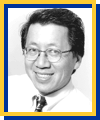
Ben Fong-Torres
AsianConnections
is proud to present the adventures of Ben Fong-Torres, our Renaissance
man: author, broadcaster, and former senior editor and writer at
Rolling Stone Magazine. This guy's our hero!
Ben
was a featured character in "Almost Famous," the Oscar and Golden
Globe-winning film by Cameron Crowe.
- AC Team
-------------------------------------------------------------------------------------------------
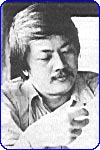 I saw my brother Barry the other night. It'd been a while
since I'd seen him, except in my dreams.
I saw my brother Barry the other night. It'd been a while
since I'd seen him, except in my dreams.
You see, Barry was killed almost 30 years ago. How, why -
it almost doesn't matter any more. He's gone, and his family and
his friends still miss him; still think of him almost every day.
At least I do. But thinking about him, and remembering him
as my wise and calming older brother, is not the same as seeing
him - something I thought I'd never be able to do again.
That is, until this videotape arrived in the mail.
I had helped to MC a tribute to Bay Area Chinese-American
television pioneers, produced by the Chinese Historical Society,
a few months ago. One of those pioneers, Christopher Chow, who was
a reporter for KPIX-TV in San Francisco in the early '70s, produced
a video salute to his fellow broadcasters. The pacesetters included
Willie Kee, Mario Machado, Felicia Lowe, Linda Shen, Linda Yu, Vic
Lee, Sam Chu Lin and AsianConnections.com's co-founder, Suzanne
Kai.
Stationed backstage, I couldn't see the video, so I called
Chris and asked for a copy. He sent it - but, to my shock, added
an extra half-hour or so of other material. He had done a report
on Chinatown on KPIX in 1972, he told me, and, among others, he
had interviewed my brother Barry, a probation officer and youth
worker. Chris thought I might like to have the report.
Tape in machine, I forgot all about those broadcasters. I
fast-forwarded to Chris' news reports, and, soon enough, found Barry.
It was a simple, minute-or-so interview. He was straight
forward, serious, talking about youths' frustrations in Chinatown.
There was nothing personal about it. He was just another talking
head, edited down to what the report needed, then eclipsed by the
next talking head.
But it was Barry. I'd only had photographs and memories since
June 26, 1972. Here, now, was a moving image. I hit rewind and watched
him again. His voice, I'd always remembered, was lower than mine,
and tinged with an accent. On video, it still was. Although he was
29 when he was murdered, he'd always remained my older brother.
Now, watching him in the year 2000, it was harder for me to think
of him that way. But that's only imagery at work. The fact is, he
will always be my big brother.
I said as much in an article I wrote in 1984 for the San
Francisco Chronicle. At that point, it had been a dozen years
since his death, and I had never written about it.
I found the process difficult and exhausting, but freeing.
The resulting story led to an invitation from the editor of Parade
magazine to write a similar piece. I received letters from around
the country, from people who, however they'd lost a loved one, felt
a bond with me, and taught me a lesson about the universality of
familial loss. One of the correspondents, I recall, was Ken Kesey,
telling me about his unending grief for his son.
That article in Parade ultimately led to my memoir,
The Rice Room.
Here's the original article, from the June 26, 1984 edition
of the Chronicle:
A
Murder That Won't Go Away
Tonight, around 11:40 p.m., it will be 12 years since my
family and I lost my older brother Barry.
He was shot down at the door of his apartment in the Sunset
District in San Francisco. He was a probation officer who worked
with black kids in Richmond jntil 1971, when he learned about a
job in Chinatown, as the director of a youth center. He was, in
a sense, coming home to his own people.
On June 27, 1972, The Chronicle's story began: "A
brilliant and respected youth worker has become the 10th
known victim in a series of Chinatown gangland slayings." There
were reportedly two assailants; the case was never solved, and my
parents forbade me from doing any personal investigation for fear
of my safety.
All we have are two bittersweet anniversaries, on May 8th,
his birthday, and on June 26th, his death. And, of course,
memories.
But I have something more. Over 12 years, there have been
few days when I haven't thought of Barry. And although the pain
has lessened over the years, there are indelible thoughts and images,
not connected as much with my brother as with his death.
He was 29 when he was killed. I was 27. Now, whenever I think
of him, he is still my older brother. He is perennially wiser than
me. In our silent conversations, he has advice for me; it is usually
calming.
I don't remember much about the wake, except that my mother
wept as I'd never seen her weep before�We handed out copies of one
of Barry's favorite drawings, by artist Ben Shahn, with the legend:
"You have not converted a man because you have silenced him."
I devoured newspaper stories about gangs. Although it pained
me that I couldn't explore the case, I was fascinated by others.
I stopped at every name mentioned, wondering.
I looked on people as possible surrogate older brothers.
I remember the brother of a girlfriend, a roommate, a fellow writer,
a male Chinese friend. But that was just wishful non-thinking. By
Chinese tradition, I was now the older brother of the family.
I am unable to listen to Bach, especially to pieces that
were on an album called A New Sound From the Japanese Bach Scene.
That was one of his favorite records, and we played it at his wake.
Whenever I come across it, I have to tune out or walk away.
Besides Bach, I find it difficult to listen to Elton John's
"Daniel" ("�my brother, you are older than me, do you still feel
the pain?).
We were both, in our own ways, rebellious. Born into Chinese
traditions, into a hard work ethic, we did our duties and earned
good grades, but managed to upset our parents with our independence.
He dated girls who weren't Chinese, and he studied not law or medicine,
but criminology. I told my parents I'd rather be a disc jockey than
a dentist.
Years later, Barry's loss inspired the bridging of a lifelong
language barrier between my folks and me. With help from a family
friend, I was able to interview them about their lives in China;
their courtship by mail; the beginnings of our family in Oakland.
I still haven't asked them about Barry. If he enters my mind every
day, he must enter theirs almost every hour.
Thinking about him and now, for the first time, writing about
losing him, shakes me up. The family of any victim of senseless,
sudden death knows that it isn't easy being a survivor.
Someday, I want to be able to listen to Bach and connect
it with Barry's life, not his death. That would make the music beautiful
again for me.
____________________
Christopher
Chow, producer of the Chinese American Historical Society's
"Broadcast Pioneers" video salute, also wrote "Casting
Our Voices," a ground-breaking history of Asian American broadcast
pioneers, reprinted exclusively here with permission.
Ben
Fong-Torres, long-time writer and editor at Rolling Stone magazine,
is the author of four books, including his memoirs, The Rice Room:
Growing Up Chinese-American, and his latest, Not Fade Away: A Backstage
Pass to 20 Years of Rock & Roll. He is Editorial Director of
myplay.com, an Internet music site that offers free Web space, where
users can grab, store, mix, play, and share music of all kinds.
Click to Ben
Fong-Torres Articles Index
Visit Ben's official site: www.BenFongTorres.com
|