| |
 |
|
|
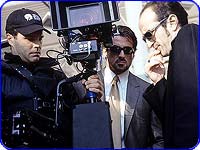
©
2000 Warner Bros. | TM & © 2000 Carter
Prods., LLC | Photo: John P. Johnson
|
|
|
Sylvester
Stallone
chats
with AC Team
about his latest movies
"Get
Carter" and "Driven"
Sylvestor Stallone talked with AC Team's Suzanne Kai during
a round table discussion with members of the press corps in Beverly
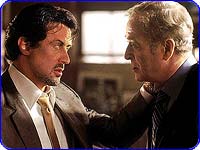
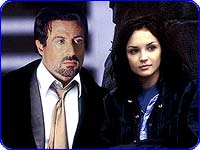
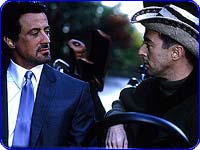
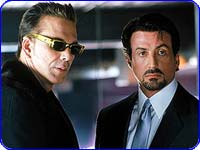
Hills. Stallone talks about his remake of "Get Carter"
and his soon to be released racing movie, "Driven."
Q:
What made you want to make "Driven?"
Stallone:
You try to find one of those titles that could be double edged.
And the fact is that they drive across, but they are actually all
"driven" in their own lives, and that's what really the story is
about, is the motivation of why do you drive. Driving is the end
result of being obsessed with a goal. Some people drive for money,
some people are trying to drive to keep back time, if you know what
I mean, like "Oh god, I hope I'm not reaching the end of my ropes,"
so they drive harder to hold back the inevitable. It's like a boxer
that goes one fight too many, he still thinks he can do it. And
that's what his motivation is, it's holding back the clock. So everyone
has a motivation for that particular venue.
Every now and
then, you become truly obsessed with an ideal or an idea. And I
just think that this particular movie is something I feel, there's
maybe twice I felt that strongly about something in my life and
what is great is because it comes with such skepticism. People are
just like, "Oh god, you know, a race car film." I say, "No, no,
no, no, no." It's the exact same thing when I had "Rocky," it's
like, "Oh, a boxing film." And all boxing films, 90% of boxing films
were made to basically get around the morals code at the time, so
guys can basically be in their underwear, jumping around in the
ring sweaty.
Whereas at that
time, they weren't even allowed to wear tank tops. Well, remember
when they had that happen one night, they had to be in separate beds
and a sheet, and him just wearing a t-shirt without sleeves, was,
you know, scandalous. So I said, "Okay." But, you can put them in
the boxing ring, jumping around basically in his underwear and get
away with it. So a lot of these boxy films were done basically as
a launching platform for the male sex symbol at the time. So you had
to overcome all that baggage, and same thing with racing cars, it's
usually, "Okay, you slept with my girlfriend, now I'm going have to
race you," but of course, someone is going to get hurt going to the
hospital or die, and they're going to come back, it's very formulaic.
So, I'm just
coming from the premise that this is a story that could be a drama
that anyone of you could live everyday, except that you happen to
be a race car driver. So the odds are so high that if you have a
fight, with a love one let's say, normally you'll finish it tonight,
you'll get home and you work it out. There you don't know if you
are coming back. So that's the difference. You're living under such
a high pressure microcosm life. Like, an astronaut goes up once
or twice in his whole life, and he faces that death. These guys
do that everyday. They do what an astronaut does, literally.
Q:
Is that what made you want to go back to writing for "Driven?"
Stallone:
Yeah, because I couldn't quite translate the idiosyncrasies and
the sub-layers, I guess, adequately. Because I tried, I would do
anything to avoid writing it, because it's very complex. You know,
when you write for "Rocky" and "Rambo," you're basically writing
for one character, who surrounds himself with satellite characters.
I'm just a player in this, so all the other characters and especially
there are many female characters, and you have to each give them
a voice, and as you are writing sometimes, the character doesn't
develop a voice. It just doesn't talk to you, so everything that
come out of their mouth is just superfluous drivel. It's like someone
calling you up at home at 10 o'clock in the morning asking if you
want to subscribe to like Field and Stream, you go, "Oh man,
this voice, I don't want to hear this sound." It doesn't have an
impact on you.
Q:
Did you have the same sort of baggage? You talked about the baggage
attached to a racing movie or boxing movie. [How about your movie,
"Get Carter?"]
Stallone:
Yes, you are
dealing with?the baggage of Michael Caine having done it so well.
So right away, you're kind of like, "Are you the new pretender to
the throne?" and I say "Yeah!" Basically yes, I am the new pretender
to the throne, but the one thing I will do is to respect Michael Caine
enough, is not to try to do a parady. So, "Get Carter" is an interesting
premise, because you live a certain lifestyle, which is being alienated
from people. You live in the dark side of [Las] Vegas.
Now, you're
at that the real crossroad in your life where, you know, you are
moving on to a point where you never really going to have a family
because you getting too old. And now, something happens where you
are forced into a whole different environment. My brother dies,
I come from Vegas, I'm totally retro. Shark skin suits, dark glasses
- he literally lives in the past, which is kind of a statement of
where his mind is. And now he goes to the grunge city of Seattle,
and he now inherited these people lives, his brother's wife, who
despises him.
They say, "Look,
you're just a picture on the piano, you never been there." So he's
never been there for anyone and now he has to be or does he want
to be. So he goes, you know what, this is the last opportunity to
do something human, that will perhaps give my life wake, because
all he's done really is chase other bad guys. It's bad guy going
after bad guy, and it's just been so redundant, and that lifestyle
is probably going cost him his life and another a year or two, he
just cannot keep it up. So now, it's like in the Joseph Campbell
tradition, he isn't born a hero, but he is thrown into heroic circumstances.
Can he rise to
the challenge of being a protector for someone else, caring about
someone else. And lo and behold, it starts to happen. And he starts
to just become overwhelmed with this young girl and being a protector
of her. And then the bad guys start coming, the Mickey Rourkes, the
Michael Caines, and the Alan Cummings. And normally he would have
destroyed them all and moved on. Now, he's just got to fight.
Cross that line,
and I'm going be running forever and so on. So he has to deal with
this and deal with this girl, because she has this very dark secret.
And when he finds out about it, it just shatters him and that's
what pushes him over the deep edge. He's going to get rid of all
this little girl's demons, even if it costs him his life, and you'll
see in the movie, I mean, it's one of those crusades at the very
end, he's going to sacrifice.
Normally he
would say, "I don't care, you deal with your own problems. See you
later." Now, he's going to lay himself out there, and basically
be on the run for the rest of his life. But at least this girl will
have a clean slate.
Q: Can
you talk about working with some of the cast members of "Get
Carter?"
Stallone:
Alan Cumming, he's from Broadway, absolutely a genius actor. One
of those people that you know, just walks into the room and you
know you are in trouble, because he already knows how to play the
game.
He would be
doing things like, I'm doing a scene where he has been a pretty
bad guy, and I'm about to exterminate him, and he's crying. He's
out in the woods, and I can't believe it, he has been the nemesis
[of] the whole movie. He's drooling and tears are coming, and I'm
thinking, "Guys, I think he's going to have a heart attack."
And then cut, and
he goes, "Want a cigarette?" (Laughter) It was just fooling then,
so watching his techniques was just absolute genius, and he's Scottish
but no accent at all.
He plays this
Bill Gate-sian tycoon, who is�unwittingly brought in to this by
Mickey Rourke. I thought Mickey Rourke has�such great presence,
no matter what he's done you just don't ignore him. So he got very
physical, he got up to like 200 pounds in this film. He's like a
real bruiser.
And [in the
movie] he is one of the reasons I [the character] left town 20 years
earlier, because he and I were getting into a serious competition
over territory. I don't need this, I'm gone. So he's always had
this hatred for me, and as soon as I come back, it's like his worse
nightmare came home, so he's going to make my life miserable.
And he does?
he has a young girl name Rhona Mitra, another beautiful actress
from England who plays a prostitute who is under his control and
he uses her to get at me. Then you have Michael Caine who is interesting,
because he's playing one of the characters that he threw off the
roof in his other movie. But we decided not to do the roof thing,
because we are taking a whole different approach. But it's interesting
having Jack Carter talking to Jack Carter of another generation.
Q:
Did he [Michael Caine] ever look at you and go, "I would have done
it that way" or "That was a good choice there?"
Stallone:
Well, he did say one thing, there's a line in there, he goes, "You
come here threatening me, if I find out you made a mistake, I just
might be looking for you, might'n I Jack?" And I go, "You know you
are a big man, but you are way out of shape with me. It's a full
time job, so sit the hell down." So he goes, "Do you have to say
WAY out of shape. (Laughter) How about just, SORT OF out of shape?
Not WAY. Come on! Way?"
Q:
Were the scripts of "Get Carter" similar between the two
versions?
Stallone: There's [dialogue] like, "Your eyes
are like cat piss in the snow," and then things like "way out of
shape," and "'Revenge doesn't solve anything.' 'Of course it does.'"
So there's these little lines from the original.
But the original
Carter that he played, we talk about this, I said that he was very
pure in a sense that he was a killer, he was a leg-breaker, and
he was totally consumed by himself. He didn't have the ability or
want to care about anyone. So eventually this nihilistic approach
eventually costs him his life at the end.
The girl who
was supposedly his daughter, or his brother's daughter, but he didn't
even touch on that, or the script didn't touch on that. It just
dismissed it. And he went around just eliminating everyone who he
thought was kind of a front to his ego, his reputation, who disrespected
him.
My character comes
in, and there's a part of him that wants to get back into some semblance
of a life, that he realizes his life has been just living in the dark,
chasing bad guys, and why has he been on the planet. He hasn't achieved
anything. So I'm a big sucker for redemption. �He finds the door open,
that perhaps he can do something that'll keep him at least in touch
with some sense of humanity.
So when he
sees the girl, and he sees the wife, he now could become a protector.
�Whereas the original Carter didn't care, that character never even
got involved. But that was part of the book, I mean it was a very,
very intricate part of the book that they didn't focus on.
So we focused
on one of my [pet] subjects, which is if we could revamp our lives,
if we can retread our lives, if we can re-live them, rewind them,
would we go the same route? Most likely, 99% of the people would
not.
They would at
least make a slight variation, you know, a couple of turns here
and there. Well, this fellow has that opportunity. Unwittingly he
falls into a situation where he is finally presented with a chance
to do something worthwhile�with his life, and that's where his physical
strength and his [inclination] for violence and his understanding
of the criminal mind actually is an asset, because it's what keeps
him alive and helps him overcome his enemies, so the young girl
can live a safe life. Because if my character disappears, she would
too. She would be the victim.
Q:
Do you have any thoughts on being interviewed by a journalist who
grew up on your movies?
Stallone:
Yes, I do. I think it's very refreshing. It's very flattering, and
I can't fool you guys.
-
End of Excerpts -
--------------------
Related:
Get Carter Synopsis
Get Carter Official Site
|