Ads used to be here |
 |
 |
 |
 |
 |
 |
 |
 |
|
|
||||
|
||||
Lia:
Why did you become a filmmaker? Philip:
Film
was one of my first loves. My two first loves were film and
music, so doing films is returning to something I've been interested
in a long time. Lia:
How many hats do you wear as an artist? Philip:
I
see myself as a playwright and a filmmaker. I have a lot of
interests and I've done a lot of things-I'm very interested in music,
and I was interested in performance, though to a lesser degree now-but
in terms of what I do now, I'm a playwright and I make independent
films. And when you do independent films you wear many hats
because you have to, so I work with my producer Dale Minami and
my wife Diane Takei in terms of putting the whole thing together.
I'd love to focus on just writing, and directing it. I don't
know when that will happen. I'd like to maintain artistic
control, so it means working with people I know and doing a lot
of the work ourselves. Lia:
How is it different working as a filmmaker than a playwright? Philip:
I
found it easier to write a screenplay than a play because you grow
up with film. I had no experience with theater growing up,
so I had to learn what a play was, and learn how to write it.
What I've come to believe is, they're very different forms, and
just different processes. And I approach it that way now.
By and large, when I see films that are directed and written by
a playwright, say Mamet or Shepard, you usually can tell, because
it is very, very difficult to get rid of that theater and play approach.
I admire both of their works as theater artists, but I think their
films don't work as well. They're just very different aesthetics.
Lia:
How did Life Tastes Good come about? Philip:
Dale
and I were planning to do another movie called Otto, which
I had written and developed at Sundance in 1997. But we couldn't
raise the money. We needed a million and a quarter for that-a
very low budget, but we couldn't raise it. So Life Tastes
Good is a story I came up with that fit our budget. We
made the type of film that we could afford to make for that amount
of money, which I recommend to all independent filmmakers.
Don't be too ambitious in terms of budget. Make the film that
you can afford to make. It
meant shooting in one location, within a one-block radius.
I wrote a story that used a warehouse almost as a character.
I went to the warehouse, sat there, rode in the industrial elevator,
sat there, and then came up with a story that could take place inside
this warehouse and the surrounding area. I wrote the screenplay
very quickly, in a couple of weeks. Lia:
Tell us about the film itself. Philip:
Normally, Asian American characters
are introduced through some accepted and familiar "Oriental"
motif or behavior-a revisit to the old country and its exotic ways;
sexually or behaviorally deferent to the white lead for no logical
reason other than the presumption of his whiteness; acting with
a motivation that confounds any normal-thinking Asian American-yet
is truthful and appropriate "Oriental American behavior"
as interpreted by white culture. I made a film that is slightly
subversive of these attitudes. I did what Spike Lee did for
African Americans with his debut film, She's Gotta Have It.
By allowing my Asian American characters to subsume roles normally
portrayed by whites, and by allowing the world to be peopled only
by Asian American characters, I am recontextualizing America's perception
of the "Oriental American." It pulls the rug out
and says, let's start over, there are new rules to how we look at
Americans of Asian descent.
Lia:
Can you talk about the technical aspects of the project? Philip:
I
shot the movie on super 16, meant to be blown up into 35MM-the stock,
processing, and camera are very expensive. In addition, if
you are shooting with 35, the cameras are big; you can't move around
as quickly and shoot on the run as easily. It really cuts
into your time. We could afford to shoot it on a three-to-one
ratio. Which means, for every three takes we used one.
Everything was storyboarded so we knew exactly what we were going
to shoot. It was all a matter of economics. I knew I
wouldn't have the time to think about what I was going to shoot
so I had it memorized. I had gone through it in my head enough
and walked through the space as the sets were being built. Lia:
Was shooting your short films different from shooting the feature?
Philip:
I
did all three films the same way. I assembled a group of people
I felt good about that understood what I was trying to do.
Storyboarding it, working with a minimal budget, minimal crew, and
making sure the project was well planned out and then shooting it.
By the feature time it was a bigger budget, bigger shoot, more actors,
more storyboarding, more people. It always felt like it was
the same process and I was expanding on it. On our half hour
short, it was trickier because we were running out of film.
Michael Chin, our director of photography, was invaluable in terms
of setting up the shots. I may have had a storyboard idea
but Michael was the one who took the idea and made it real. The
idea of the film was to create a model that I could do more than
once. I wanted to create a team that will continue to work
together over a period of time, a group that trusts each other.
I'm thinking about five or ten years down the road. I executive
produced, directed, and wrote the screenplay. But I surrounded
myself with a great team, with attorney Dale Minami as my executive
producer, my wife/producer/actress Diane Takei and producers Pamela
Wu and Wendy Braitman, director of photography Michael Chin, film
editor Maisie Hoy, Hiroshima composer Dan Kuramoto, production designer
Kate Edmunds, and costume designer Lydia Tanji. It
was important that by the end of the film everybody on the crew
felt good about the work. Usually on a low budget film everyone
just burns out, but everyone felt really good and I still get calls
to see when I am going to do my next project. I've found the
key ingredient to a successful shoot is serving really good food.
Lia:
What was the Sundance experience like? Philip:
Even
when you come in with a short film, people are very attentive.
They don't make you feel less than (important). You get invited
to the Z parties though. With a feature you're higher up and
get closer to the A parties. They put you in the middle of
the event, with the press, and you meet people at the screening.
You are much more in the center as opposed to on the fringe. I
was a screenwriting fellow and also in the directing program, so
I was brought to the producer's conference at Sundance. I
sat with producers from around the world, and they're all very bright,
the tops in their fields. All of them told me, "To
be perfectly honest with you, there's no interest in Asian Americans."
This was told to me by a woman who handles most of Asia, a fellow
who handles Europe and has found funding for really difficult films,
and by someone domestic too. It wasn't anything that we hadn't
heard before. I'm
convinced there is an audience out there. We have to convince
some distributor that this is worthwhile, and it can make them money.
It was never meant to be a blockbuster. It's a small film
that can appeal to enough of an audience to make back the money
so we could do our next film. That is our goal.
Lia: Going back to something you said earlier, you mentioned
that you were interested in music. What kind of music? Philip: I played the guitar in bands, I
wrote and sang, I played in coffeehouses and clubs by myself, and
I played with groups backing me up. I even auditioned as a singer
for the band Hiroshima, and my friend David Henry Hwang and I played
in a band called BAMBOO, around 1980-81. He played jazz violin and
I played guitar and sang. It was all original material. At
that time, in the 1970's, I was writing about being Asian American,
with folk-rock songs entitled, Ballad of the Issei and All-American
Asian Punk. I recorded demos and I sent them off to record companies
and did that for a good period of time. And guess what? Nothing
happened. I thought one could be commercially successful singing
and writing songs about being Asian American. I sang at community
functions and political events, but with the commercial market,
there was no interest. And that was fine. One of things I've learned
is that you play to your strengths. It wasn't happening, and the
world seemed to be telling me that, so I sat back for a while, and
then I took off again in a different direction. Lia: Do you think the scene is different now for young artists?
Growing
up, my interests were many: I painted, played music, wrote. I think,
as I got older I felt I had to become a category. I had to become
one thing. But instead, I've been fortunate enough to be able to
revisit the interests I had when I was younger, before I felt I
had to categorize myself. I enjoy following my gut impulses. I'm
at a point now where I feel free and comfortable enough to just
do what I want to do. As a consequence, I did a spoken word performance
piece with Dan Kuramoto, where we formed our own retro jazz ensemble,
the new Orientals. It was fun to get up on stage with Dan
and work with live music and very smart musicians. (Danny Yamamoto,
Taiji Miyagawa) Filmmaking
was the same thing. At one point I felt I wanted to make my own
films. By and large, the world was telling me no. You haven't
made a film, and if you haven't made a film we can't give you money.
So I got some money and made a film. And then I got more money and
made another film. Filmmaking
allows me to engage all of the interests that I have. It's music,
it's rhythm, it's visual, it's painting, it's literature, it's performance,
it's direct human contact, the directing aspect, it really involves
everything. And it also involves business, a lot of negotiations.
The business part I'm not very good at, but I work very hard at
it. As an artist you MUST be responsible for the business side of
your work. I align myself with people whom I feel make me stronger.
Dale, Diane they all help structure me and structure this team.
I know that I am not capable of doing all of the things myself,
I know my limitations. KNOW THYSELF. Know who you are. Highlights of this profile updated in November 2002, have originally appeared in the Fall 1999 edition of DIALOGUE, a publication of the Asian American Arts Alliance. Copyright 1999 by Asian American Arts Alliance. All rights reserved. |
||||
|
|



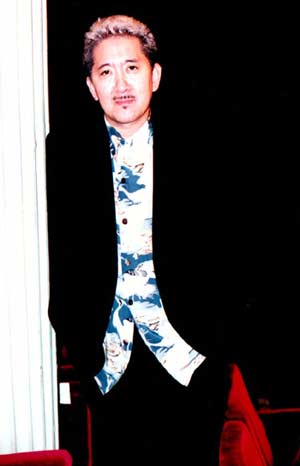
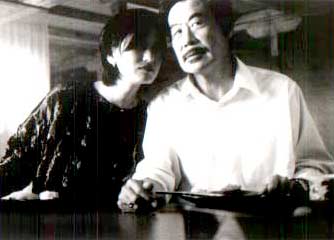
 AsianConnections
Arts & Entertainment Editor Lia Chang (left) currently appears as
Nurse Chang on As The World Turns and One Life to Live.
She is an accomplished stage, screen and TV actress, photographer
and writer based in New York City. AsianConnections wishes to thank
Lia and Philip Kan Gotanda for their generous time and efforts in
making this interview possible.
AsianConnections
Arts & Entertainment Editor Lia Chang (left) currently appears as
Nurse Chang on As The World Turns and One Life to Live.
She is an accomplished stage, screen and TV actress, photographer
and writer based in New York City. AsianConnections wishes to thank
Lia and Philip Kan Gotanda for their generous time and efforts in
making this interview possible.  |
|||
|
 |
|
|
| | About Us | Disclaimers and Legal Information | Advertise With Us | We welcome your comments. Send e-mail to us at info@asianconnections.com Copyright ©1999-2002 AsianConnections.com |