Ads used to be here |
 |
 |
 |
 |
 |
 |
 |
 |
|
A
Roundtable Discussion with
The "Notorious" Margaret Cho (Part 2 of 2) ("Notorious C.H.O.") by Lia Chang |
||||||
|
||||||
|
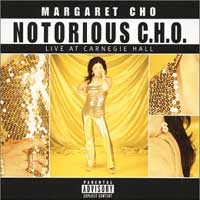
AsianConnections' Lia Chang caught up with Margaret Cho in New York July 1 on the premiere of her new concert film "Notorious C.H.O." - a follow-up to her hit concert film "I'm the One that I Want." "Notorious C.H.O." filmed live in Seattle, is a hilarious, bawdy one-woman show inspired by the raw comedy of Richard Pryor, George Carlin and the female machismo of rap music divas L'il Kim and Eve. In Part 2, Margaret shares her thoughts about Chris Rock, having control of her work, and even her occasional appearances on HBO's Sex and the City!
On comedian and actor Chris Rock I think he's great. I think he's incredible funny and bright, he powerful, political and honest. I love what he is doing. I think that he is really brilliant and I am very proud of him. On having control over her work Absolutely, as far as I can go. If I can enlist different networks to work with me. The longer that I am around, there is a greater possibility. With the work that I do, I have been doing it for so many years that the appeal in itself is undeniable. I am kind of looked at as a sure thing in so many ways, that I can imagine in the near future that everything that I want will happen. I do want to self-produce for as long as I can but if I can manage to get the powers that be to agree with me, I think that I would to work in that capacity as well. On sensing any change in the Entertainment or sitcom industry since All American Girl I don't think that it has gotten that much better. I don't think racially things have changed all that much. There have been a few instances where people have done one or two shows that are great racially, like ER does a really good job. There are couple shows that have just really showed that they can be multicultural. On awkward moments It's rare when it happens when I'm on tour because when I'm tour I do the show as it is for months at a time. It's just solid, like a Broadway show or something, it just goes. When I am writing, certainly when I am going through the development process of writing a new show, I have no idea what is going on, it is very scary. I have no idea what is going to happen. There are all of these people that just trust me so much that I have to take it somewhere. It's hard. It's the love of live performance. I love that kind of not knowing. I don't really stay in that moment of uncomfortableness too long. It's pretty tortuous. I try to get out of it by doing something that I know works, by taking an extra little risk. On overcoming shyness as a little girl I don't think I've overcome that. I think that I am pretty shy still. I don't feel like an outgoing person, I don't really feel that comfortable talking about myself. In my work, it's a different think. I am there specifically to entertain the audience. It's really not about me, it's about them. I focus on the audience so much; it's their experience that I am concerned with. So I don't really let that overcome my shyness. I still feel very shy. After shows I have these receptions. People have parties for me. I find that horrible because I have to sit there and talk to a million people. I am so terrified in those particular situations. I don't really go out a lot when I am at home. I don't really have a huge circle of friends. I have very close friends that I love but it's not like I am a big social butterfly. On starting the show with some material about 9/11. The way that we were feeling at the time, there was no way that you could not get away with it. It was on people's minds so much. At that point, we shot the film in November, it was right then. I wanted to find a way to talk about it that would not offend anybody but at the same time allay the tension around whether or not I was going to mention it. It was important for me to do it the right way, very sensitive thing, very hard to talk about, very hard to make funny. I found a way to kind of work around it. On children and animation. I love children. I would love to do an animated series that I worked on. When the film is going to be in theaters I've made an animated short film that will be a companion piece to this film. That will go before this film. It's really funny and I would like to see more of that. I made that film in hopes that I could go back and do a series of films like it. After 9/11 I think I just value my life more. I think I value my time more. It changed the whole world in the way that we view ourselves. And the way that we treasure our lives and our loved ones. I think it changed the way that people view politics. I think that it made the political agenda much more immediate. I think made people pay much more attention to the news, more than they ever have. They are more aware of what's happening in the world. Now these concepts such as war and terrorism are not far off situations. They are really happening and they are real. I think that it changed the racial landscape of America too because it made people question what Americans really look like. I thought that was really interesting, really horrible thing for Arab Americans, really horrible thing for Muslim Americans dealing with racial profiling. It really threw our country into a completely new place than we had ever been. It was fascinating. As somebody who works as a social critic, it is fascinating for me. But personally how it affected me, I try to love people more. That I try to be more present. That I try to be a little bit more aware of what is going on not just politically, but physically with myself.
On having parents in the audience You know, I want to I wish that I could just talk about going to college, having a masters degree, and all the things they would like for me talk about, having a husband who's also Korean. There's nothing that I could say that would be honest. They really love my work. They get into it in the way that they can. I don't think they fully understand my friends and I were seated at the premiere with my family. My friend was sitting next to my father and the whole time he's laughing at the whole show. Then the whole thing about fisting comes up and he's stonefaced. They can't really relate to certain things. They can't really understand certain things, but they accept it all, which is really great. On whether she had to explain any of her material to her parents No. They don't mind if they don't know. On what makes her mom a better comic target than her dad I think my Mom has a better accent. My father doesn't really have that much of an accent. He sort of has let it go. My mother has a thick one, it's fun. I always made fun of my mom as opposed to my father when I was growing up because I was always really scared of my father. So we could never make fun of. And I think part of growing up Asian American is that you automatically make fun of your parents 'cause they're so foreign and that's so funny. And we can't believe that they are so funny and that we are so American. I was really embarrassed by my family when I was growing up. Oh my god, my mom makes beef jerky out of fish! We would make fun of them constantly. By making fun of them and all of the Asian American kids making fun of their parents that created a common language amongst ourselves. A kind of really for the first time becoming Asian American. It was a very bi-cultural experience. That's what my impression of her is based on. Something that I have been doing since I was very young. On her home. I live in Los Angeles. I live in an old mansion that was built in 1924. That I am slowly and painstakingly restoring. It's very rough going but it is a beautiful house. I live with two dogs. I'm pretty into living on the West Coast but I would love to come and live in NY at some point. I've always wanted to live here. I spent several months here at a time. I know that with my next show my plans are to stay here and do it on Broadway. That's my goal. What I think would be the best for me. On writing new shows I've just started writing. It's really about Asian American identity. It's about race. I think that it is probably going to be more political than my other shows in a current events way. I've just started so I don't know what it really will be. It takes about a year for me to write a show. On what prompted her to concentrate more on race It just was interesting to me right now. I read Frank Wu's Yellow which was incredible inspiring. He is just so eloquent in the way that he has presented all of these ideas about Asian American and about how much we have been pandered to by society. That there is all of this subtlety in racism that happens with Asian Americans. It illustrates how all of these instances have made him over time really feel uncomfortable here. There are a lot of ideas that I got from him that I would like to work on. In my own self. Maybe getting older and coming up and realizing there is a new generation of kids growing up behind me that are redefining Asian Americans and redefining themselves as this culture. On what she would like the Asian American community to know about her now and in the future I think that now it very steady. At the point that I am at now because I have been around for so long. There are all these kids that have grown up with me. I feel very secure there, I feel very happy there. I'd like them to know that would like to continue working on their behalf in terms of entertainment, in terms of activism, in terms of politics, there's a lot of things that I think still need to be done. And I think that my experience has been valuable because I have been around for so long. You are pretty much the only Korean American celebrity in the United States. What do you chalk that up to? What is the lack of Korean American representation in the media about? I think that it's about the way that we are brought up. Because there is no encouragement to go for careers in the arts. I think that Korean families, there is such a hold on the children, that they are so completely driven and controlled to do certain things with their lives. That Korean community is so about family values and they have such a hold on the kids. They don't want to venture into other careers other than doctors or lawyers. Korean culture idolizes education -- it's so important. We are not encouraged to go for things that we dream about, to be filmmakers, or artists or comediennes. We can be musicians but we have to be cellists. The feeling with the family has to do with the control they have. It's just so hard to break free from. That's what I think holds us back in a lot of ways and at the same time pushes us forward in other industries. It is a strange place to be because we are given all of this fire and drive but it is directed towards things that we don't necessarily believe in. I know that there are a lot of people my age that are now in careers that they don't want to be in. They are very frustrated with their lives and their families because they are stuck in this place. I was just afraid that I was going to turn into that so it was very important for me to do my work. On advice The answer is within themselves. We all kind of know what we want to do. People that say, oh I don't know what I want to do. I don't think that is entirely true. I can't speak for other people. I know that I have always known. The things that I had problems with were when people told me, oh you can't do that. Like my mom would say, "Oh no Koreans can't do that, they cannot be in entertainment." Or that Koreans don't do that would go in mind and would prevent me from taking certain risks. So I would encourage people not to listen to the voices that are going to do that to them. I would encourage people to listen to their own opinions count more than anyone else's. That's not just Asian Americans. That's not just Korean Americans. That's everyone who wants to do something that's different, or something that takes a lot of guts and ambition. That they've got to make their voice the loudest one that they hear. On why she decided to do Notorious C.H.O. as a theatrical release rather than a cable special With specials, they have a time constraint and my shows generally; I would like to do 90 minutes. I didn't want to have to cut the show and have it fit into somebody else's box of what they wanted for it. I wanted to release the film and be free enough to do what I wanted to do. On the collaboration that goes into making the show That's collaboration between myself and the director, and the producer. We all have a say in how things are going to be structured. I do the shows completely on my own and then the film is very much collaboration. On who convinced her parents to be interviewed They were happy to be in it. They're so media savvy though. Being on camera, sound bites. Totally intentionally. They really love the attention. I think it is really great. I think they come off so cool and elegant and eloquent. I am very proud of them. On how she discovered the desire to tell funny stories I just knew that was what I was going to do. I knew very young. I knew that this would be my career. When I started I had felt so uncomfortable being in my own skin. Very uncomfortable being my own self. As a performer, that was the only place, on stage, that I felt safe. I did comedy clubs. I did performances at my school; I went to a high school for the performing arts in SF. I loved it. On the difficulty of doing standup as an Asian American One time I was doing a show and I walked up to the marquee and there was this picture of me but it was a drawing with somebody with a queue (the long braid like chinese workers had on the railroad) and buckteeth and eating a bowl of rice. It was so incredible. I was so mortified. The caption read: Margaret Cho: proof that the Chinese are no laughing matter. I'm not even Chinese. It was so incredibly racist and it was advertising ME. Wildly insensitive types of things, very racist things would happen. You can't do anything. You just take it with a grain of salt and you just keep going. Stuff like that happened all the time. On racism and the Abercrombie & Fitch issue More on the defensive and angry a lot from the very beginning because I couldn't believe that people were so silly and stupid. But it happens now. Things happen nowadays that surprise me. After the whole Sept. 11 thing, a journalist asked me how it felt to be part of the Axis of Evil. Korea is part of the Axis of Evil. So now I am part of the Axis of evil. And I said, what is that like, Access Hollywood? It was crazy but people just have such a casualness about racism against Asians. That there is a really an agreement in society that this okay. Typified by Abercrombie & Fitch who put out a line of t-shirts with very racist Asian depictions on them. This is SO not acceptable and yet it was done by this huge corporation. And they excused it by saying they had asked Asians in the office and they said it was okay. It is not okay. I'm inspired by the kids from Stanford who started a huge boycott of Abercrombie & Fitch and got kids from all over the country to go and boycott the stores and got the t-shirts off the market immediately. The younger generation is really flexing their political power. That's what's really inspiring to me. On the universal nature of her material I think it's universal in a lot of ways. It works on different levels for people. I work on that. I try to make it inclusive and universal at the same time. On whether or not it's difficult to reconcile differences in her audiences It's hitting everything. It's more fun that way. Because it is so diverse. That's what I love about the audiences that come to see me. They are so different. And yet they find so much joy in this one common thing. I think it's great to do it all. On the link is between sexuality and performance There's a big link. There is certainly a kind of fluidity that I had that is very similar to what I have sexually. There is a lot of transference. Like a transfer a lot of sexual energy into performance. It is so physical and so hot in a way. I find it's such a great way to enhance my own self-esteem to perform well. Which inevitably helps me to feel more attractive. I'm encouraged. On sexuality Doesn't really matter to me. The fact that I don't want to be labeled is really about. The idea that labels is not for the gay community. They are for the straight community so that they can tag us like we are wild game. I don't think that's right. I think that labels in a sense serve us politically but not enough to always have to use them. When we all have equality, when all of those labels don't matter. Yesterday, this woman was talking about how it's not a parade, it's a march. We're not at the parade level yet because we are not celebrating our equality. We're marching for our right to equality. It was so important to point out. That's how I feel about labels. When we can stop using them, that's when we are truly free. On international audiences In Scotland, it is rare to have women monologists. My shows are very shocking in Britain. Women aren't speaking about sex in the same way. The audiences were very traumatized. In Australia, they're so excited by what I am saying. There is such a large Australian Asian community that is completely ignored by the media there. The excitement about my work is so strong. Canada is similar to America. I always knew I had to make my own path. I never felt safe at home anyway. I never felt safe with them. I do now. I'm grown up and they have to do what I say. I'm glad that I came from there because it gave my rebellion meaning. I love the city, I love the people, I love the way that people are smarter, cool better fashion here, better food, so beautiful in so many ways. I get so inspired here by so many things and I feel good here. On her appearances on HBO's Sex and the City and other roles Sex and the City was great. I am friends with Sex and the City writer Michael Patrick King. He loves me and I love him and he wanted to write a part for me that would be perfect so that's how that worked out. John Woo who directed Face Off is also a fan and I met him through Chow Yun Fat who insisted that I be in a John Woo Film. On labels and political correctness It serves me and it doesn't. Do I as a minority artist have the right to talk about my life as it is? And I think that I do. I'm not making fun of a caricature of somebody; I'm talking about somebody in my life and someone that I am very close to. What I think about that kind of PC is that it is just as oppressive as what it is trying to eradicate. PC can be really annoying. I wish we could have more fun. And unfair, and racist, and homophobic in it's own way. Narrow-mindedness. On Asian women in the media Lucy Liu Powerful sexy Asian woman. There needs to be more. I think it's great. I like Lucy Liu a lot. Her visibility helps a tremendous amount. There are so few images. I don't have anybody that I could look to as a Asian American role model. I'm so proud to be where I am in the Gay community. Advancing us politically. That's really important to me. Filling each moment. On being Asian and in the entertainment business The most difficult place to be in. [It's a] very hard thing as a performer to do. So few opportunities out there that we must create our own opportunities. I have my own production company. I generate my own work, writing books and don't have to rely on a studio or a network. I encourage others to do so. That's the only way that I think we can survive or thrive. On her relationship with other Asian American actors from her TV show They're all friends of mine. We have a really great bond. It's rare that Asian Americans get to work together. You never get to see other people. We became like a family, really connected. Bd and I were crying because they had us making Spam and eggs on the show. One accurate thing. Great moment. The friendship among the cast members has lasted for years. |
||||||
|
|





 AsianConnections
Team Correspondent Lia Chang (left) is an accomplished stage, screen
and TV actress, photographer and writer based in New York City.
AsianConnections wishes to thank Lia, Margaret Cho, and AC's Suzanne
Kai (middle) and Paul Lee (right) for their generous time and efforts
in making this interview possible.
AsianConnections
Team Correspondent Lia Chang (left) is an accomplished stage, screen
and TV actress, photographer and writer based in New York City.
AsianConnections wishes to thank Lia, Margaret Cho, and AC's Suzanne
Kai (middle) and Paul Lee (right) for their generous time and efforts
in making this interview possible.  |
|||
|
 |
|
|
| | About Us | Disclaimers and Legal Information | Advertise With Us | We welcome your comments. Send e-mail to us at info@asianconnections.com Copyright ©1999-2002 AsianConnections.com |