Ads used to be here |
 |
 |
 |
 |
 |
 |
 |
 |
|
An
Interview with |
|||||||
|
|||||||
|
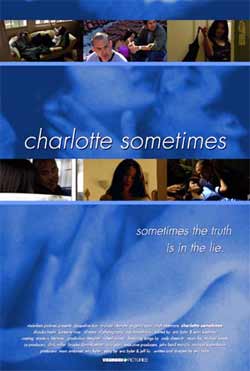
"Charlotte Sometimes" is an intriguing film by director/writer Eric Byler. The story centers around the concepts of loneliness and loyalty, romance and betrayals. The film has been making the rounds at film festivals and has attracted considerable attention through its story-telling and production values. Recently, it received the "Special Jury Award for Narrative Filmmaking" at the Florida Film Festival and was reviewed positively by Variety. AsianConnections caught up with writer/director Eric Byler to get his insights about this innovative film about the human experience.
Eric Byler: Another movie came out with the title Better Than Sex, so we had to change it. I was never quite happy having the word sex in the title, which isn�t very subtle. Charlotte Sometimes is a song by The Cure from the early 80�s. As it happens, the character Jacqueline Kim plays in my film is named Charlotte, although like the character in the song, she takes other names. When I first got the idea, I went to Jacqueline with an old Cure CD and said, what if we call the movie Charlotte Sometimes and you do a cover of this song? I'm always pleased when audiences stay for the credits and listen to Jacqueline sing. Robert Smith's poetic observations on loneliness and longing take on a new light when it�s Charlotte herself who sings them. I think it's the same sense of isolation that drew a lot of Asian Americans to alternative music like the Cure -- not so much in Hawai'i where I was, but in parts of the country where there are less Asians around. A lot of Asian Americans know the words to Charlotte Sometimes and what it's all about. AsianConnections: I noticed that much of the time, the music was critical to conveying a meaning or establishing a mood. Can you speak more about the role music played in the film? Eric: Michael Brook is an incredible composer. My collaboration with him has been one of my most rewarding experiences as an artist. He watched a rough cut of the film, and wrote 40 themes, only one of which was intended for a particular scene. Michael suggested that I match music to scenes myself, and edit them so they fit the picture. Michael then took my re-edited versions, and crafted the finished cues. He played all the instruments himself, except for the percussion. I'm amazed when people say they like the film but didn�t really notice the music. I guess that�s a tribute to Michael and his ability to weave music subtly and seamlessly into an understated cinematic approach. Cody ChesnuTT has four songs in the film. Cody voices some of the thoughts the main character sometimes feels but would never say. Seven Year Bitch also contributes an important song that gives voice to Charlotte's inner rage. Cody and the lead singer of Seven Year Bitch, Selene Vigil, are friends of my co-producer Brooke Dammkoehler. AsianConnections: I understand the film was originally shot digitally. Can you describe the set-up and how going digital has been different from the traditional way of making films?
Eric: Charlotte Sometimes is a character driven film that relies heavily on the audience believing in the characters' humanity. This may not be true of most films, but I can honestly tell you that Charlotte Sometimes is a stronger piece for having originated on DV. Because tape is so much cheaper than film, I had room to experiment, make adjustments, and improvise on set. This flexibility proved essential in designing layered performances, and creating the "illusion of the first time." For instance, rather than saying "action," I sometimes instructed the actors to begin with an exercise we developed during rehearsal, and slide gradually into scripted dialogue, only when they were ready. Amidst the noise and bustle of low budget production, the actors knew they had time, if they needed it, to forget the chaos, and believe the illusion, before immersing themselves in a complex or difficult scene. AsianConnections: Related to the digital aspect, there was an amazing amount of difference in quality when watching the screener on tape as opposed to the 35 mm version. Yet there was no "35 mm version" filmed per se. Can you tell us more about the process used to convert from DV to 35 mm? Eric: There's a new technology, I think it's called the Ari Laser, that allows DV to be blown up to film with very little loss of resolution. Our DV master was bumped up to high definition, color timed, and then blown up to 35 mm off of a high definition, D5 deck, which is the highest grade deck available. I think Charlotte Sometimes is the first film to use both the Ari laser and the D5 deck in conjunction. Alpha Cine Labs in Seattle could tell you more about that. Contact Jannat Gargi at jannat@alphacine.com. AsianConnections: What motivates you as a filmmaker? What do you try to achieve in telling a story through film? Eric: My motivation as a storyteller stems from a desire to let other people into my world. I guess I want others to visit from time to time so I don't feel alone. Film is my medium of choice because film comes closest to replicating human consciousness. Film can employ instantly juxtaposed images, as well as music and sound, to communicate, not just information, but experience. Film has the potential to share a subjective point of view -- as unique and as personal as dreams or memories -- with millions of people.
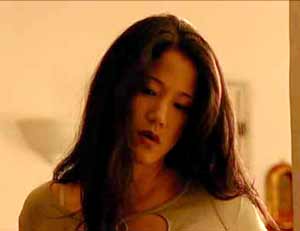
AsianConnections: How did you find the actors for Charlotte Sometimes? Was it particularly difficult to cast each of the roles? Eric: Four were easy, two were hard. I wrote the title role for Jacqueline Kim. And I offered supporting roles to Shizuko Hoshi based on her work in other films, and to Kimberly-Rose having worked with her back in Hawai'i. I knew I wanted Matt Westmore as "Justin" after the first round of auditions. In the second round, I focused on a dozen, very strong candidates for "Michael" and "Lori." Eugenia Yuan and Jae Suh were neck and neck for the role of "Lori." "Michael" was more difficult for me to narrow down. Burt Bulos had caught my eye, and sort of changed the way I envisioned the character, but his agent called to say he was no longer interested. So I decided to ask two actors who chose not to audition to enter late in the game. One was Jeff Liu, my friend and writing partner, who had played the role during the development stage. The other was Michael Idemoto, who I'd seen in "Sunsets" (which he also directed) and in the short film "Breezes" directed by Justin Lin. Meanwhile, Burt told me his agent had made that call without his knowledge, so Burt came to final callbacks as well. The other invitees to final callbacks were D.W. Sweet and Michael Lee. Jacqueline flew in from New York to read with her five potential love interests, and her two potential opposite-rivals Eugenia and Jae. Eugenia edged Jae out for the part of Lori, and I had to make a very difficult choice in casting Michael Idemoto over Jeff, who had delivered a powerful interpretation of a character he helped create.
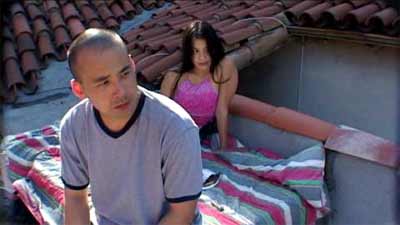
AsianConnections: Can you comment on the camerawork in the movie? Eric: Well, Rob Humphreys is amazing. He totally believed in my vision, and even reminded me of it if I started to stray. In storyboarding and composing shots, we tried to create distance, and allow room for a sense of truth, or realism. Instead of close-ups lingering in the eye-line (line of sight) of the actors, we're giving you long lens shots through veils or through windows, or with foreground objects creating a frame within the frame. My aim was to give you the impression that these events happened only once, and the camera could only see what it could see. Also, I guess subconsciously, you might feel like the camera is placed in such a way that the subjects might not be aware of its presence. I knew it wsas a risk not to give you that privileged point of view you�re used to. But my theory was, if you consequently believe that these people you�re watching are not actors but real people, you�ll start to implement the same powers of observation and intuition you use to decode people in real life. This allowed me to get by without expositional dialogue, which I really, really hate. I find that in real life, people rarely explain their deepest fears and hidden desires in the words they say, in fact, it�s quite the opposite. So, in Charlotte Sometimes, we use dialogue not to show but to hide. We do our showing in the visuals. AsianConnections: The film has been making its round at various film festivals now and gaining a lot of press. Ben Fong-Torres had a lot of positive things to say about it in his last column on AsianConnections. What's the response to your film been like, and where can people see it in the coming months? Eric: I�ve just learned that the film was accepted at the Hawai'i International Film Festival, November 1st thru 10th. We have some other tempting invitations, but we also want to limit the film's exposure, so we're weighing our options. As for the response, well, our reviews are very strong. Asian and non-Asian viewers seem to enjoy the film equally. At South by Southwest, where we won the audience award, there were only 6 Asian people who saw it. AsianConnections: What are some current and upcoming projects? Eric: I was hired to adapt Shawn Wong's novel American Knees to the big screen for Starz, who recently produced Tortilla Soup along with Samuel Goldwyn. American Knees is also a character driven Asian American drama, but I�ll have to win the job as director before I can say much more about it. I'm also raising money for "Kealoha: The Loved One," a coming of age story I wrote that�s set in Hawai'i. I�m also working on my first mainstream (no Asian people) script, inspired by a novel by Prof. Howard Bernstein. AsianConnections: Do you have any words of advice for aspiring filmmakers, particularly in the Asian American community? Eric: Writers always tell other writers: write what you know. It's true of filmmaking too, but for the Asian American filmmaker, I'd like to add one thing: You know more about life than just being Asian. Our stories, yes, even the personal ones, are worth telling. Other filmmakers have earned the right to make art without an ethnic agenda. So can we. Just tell the truth, even if it hurts you, especially if it hurts you, tell the truth. Charlotte Sometimes can be seen at the Washington D.C. Asian Fest and the San Diego Asian Fest. For more information, visit the official Charlotte Sometimes Website.
|
|||||||
| AsianConnections wishes to thank Eric Byler for contributing his valuable time for the interview for which this would not have been possible. |



 |
|||
|
 |
|
|
| | About Us | Disclaimers and Legal Information | Advertise With Us | We welcome your comments. Send e-mail to us at info@asianconnections.com Copyright ©1999-2002 AsianConnections.com |