Ads used to be here |
 |
 |
 |
 |
 |
 |
 |
 |
|
East West Players Honors Jet Li, Lea Salonga, and Others at Hollywood Gala |
|||
|
|||
|
AsianConnections catches up with Amy Hill, John Cho, Tim Dang, and others. Click here for more event coverage Los Angeles April 22, 2002 Action star Jet Li, Tony award-winning stage actress and singer Lea Salonga, The Ralph M. Parsons Foundation, and longtime theater volunteer Irma Escamila, were among the honorees at East West Players star-studded 36th anniversary Visionary Awards dinner. East West Players, the oldest Asian American theater in the United States drew more than 800 guests to the awards dinner and silent auction at the Westin Bonaventure Hotel in Los Angeles. Jet Li, fresh from the set of his latest film production, Cradle 2 the Grave was presented a EWP Visionary award by famed director John Woo. Jet thanked the audience for his award in his native Mandarin language which was translated into English by Roberta Chin of Pinetree Productions. Joseph Hurley, President of The Ralph M. Parsons Foundation accepted the Visionary Award with his family at his side. Rae Creevey award honoree, Irma Escamilla gave a moving speech of gratitude for her honor. She has worked as an EWP volunteer in numerous jobs from stage management to production and set design since 1979 AsianConnections' Suzanne Kai, Paul Lee, and world champion martial arts fighter Cung Le attended the event to photograph and interview the honored guests. A silent auction with proceeds benefiting the theater, offered treasures from autographed movie memorabilia to trips to Asia. Kai was the winning bidder of a Rush Hour 2 script personally autographed by Jackie Chan, Chris Tucker, and director Brett Ratner. Actor/writers Amy Hill and Alec Mapa emceed the evening which included performances from Lea Salonga, Michael K. Lee and a musical comedy number performed by Gedde Watanabe with Diana Toshiko, Yumi Iwama and Kerry Carnaham in Geisha costumes. Hollywood luminaries were on hand as presenters and commentators including director John Woo and Terence Chang of Lion Rock Productions, Fritz Friedman of Columbia Tristar at Sony Pictures Entertainment, NBC executive Scott Sassa, actors John Cho, and Michael Paul Chan. Sabrina Lu and Lauren Tom introduced EWP's Theater for Youth with performances by Alice Lo, Kurt Kuniyoshi and Casey Kono. Lauren Tom is currently filming a TV pilot featuring an Asian American family for ABC. Member of EWP's Council of Governors, Actor George Takei made a special appearance to congratulate the organizers of the anniversary event. AsianConnections producer Paul Lee chatted with honored guests and organizers throughout the evening: Tim Dang, Artistic Director, East West Players Tim: I think this is a very important event because with the Asian Pacific community growing [by] leaps and bounds in California, it's about time that we recognize the achievements that Asian Pacifics have made to the contributions of America. Especially our artists. Art, many times leads the way in terms of the way that people perceive who or what Asian Americans are. Paul: Is the state of things today for Asian American artists much different than ten years ago? Tim: It's a lot better than it was ten years ago but there's still alot more work to do. Of course you can see all this support in terms of everyone who wants to help improve the visibility and raise the visibility of Asian Pacific Americans, that I think in the next ten years it will be even better. East West Players is a leader in producing Asian Pacific works that give voice to the Asian Pacific communities. It's a pan Asian organization trying to represent the Vietnamese experience, the Cambodian experience, Chinese, Japanese, Taiwanese, Filipino, Korean so what we try to do is shed light on those particular experiences to the greater mainstream community. Paul: What can Asian Americans do to support Asian Americans in the arts? Tim: Go see their shows, go see Jet Li movies. So what happens is this will let the studios know that Jet Li can get a $36 million dollar opening week gross. That's good, that means that Asians are box office. So that way you will see more Asians. In terms of TV, if you have more Asian images on TV with a popular show, again people will say, "Oh, Asians are box office successful." Same thing with plays. In terms of the more Asian plays in the theaters, the better it is for all of us.
Jet Li: (translation by Roberta Chin, Pine Tree Productions) Jet: When I came to America for the first time in 1974 I already saw that there were alot of Asian Americans friends who had been trying to make a melding between the Eastern and Western cultures. Actually, at that time I was thinking why aren't you guys out there making money instead of doing these things that nobody knows? [audience laugher] But gradually when I grew up I began to understand that without those people clearing the paths for us there would be no opportunity for Asian actors to be where we are today. [audience applause] From the bottom of my heart, I want to share this award with the countless people who have worked so hard that maybe nobody knows who are clearing the path for us in melding the Eastern and Western cultures. I hope from the bottom of my heart that I will continue to work harder than I am now to hopefully spread my culture so that we can promote world peace. [audience cheers and applause] Amy Hill, co emcee of EWP Visionary Awards Paul: How significant is this event for Asian Americans? Amy: I think this is the big event for the Asian American community. It brings out the celebrity star power which is really most people immediately can tangibly feel proud of, even though there are a lot of things that we are proud of Asian Americans doing. It brings everyone together to celebrate being Asian Americans. Paul: Is this event even more important now in light of the demise of some of the Asian American magazine and online ventures failing? Amy: Yes, it continuously is important because of that. We have to keep our spirit looking forward and moving forward and moving bigger and higher and better, always. Paul: What can Asian Americans be doing to support Asian cinema, Asian theater, Asian actors? Amy: Well, going to it is good. I'm doing a show in San Francisco at the Asian American Theater Company. Asian Americans are not big theater goers right now yet. Sometimes they may go to the [Mark] Taper Forum, or maybe they may go to the Opera, but what's weird is if you go to Asia people go to see stuff. Lots of people line up to see things [in Asia], but for some reason [in the U.S.] they feel like they're not getting the best product if they go to Asian American theater or Asian American film. They've been sort of brainwashed with the idea that stuff that is possibly ethnically oriented, or not mainstream might not be good, but it is! Paul: There is disparity in terms of perception? Amy: Yes, I think probably Asian American stuff probably does better in Asia than it does here! I've been flown to Singapore to do my show and people are just like, "Wow! Amy Hill, All American Girl!" And here, I think sometimes...people that are not Asian are more impressed with me than Asians. Because [Asians] feel, well, I'm just family. It's kind of a weird thing. We criticize ourselves too much, we don't support each other enough. Paul: What about Jet Li, people say that he has made a lot of advances for Asians in film, but others might say he is perpetuating the Asian stereotypes in martial arts. What is your opinion? Amy: I feel that when you are doing something really well, and people are applauding that, you just got to keep doing it. Do not worry about stereotypes and all that type of stuff. It's the thing that we do to tear ourselves down again. You just gotta get out there and support them. In terms of communication and talking, the more that Jet feels he [is] embraced by our community, the more he could take on some of the ideas that we have in maybe expanding the possibilities for his work. That maybe it won't always just be that, maybe it might be a little different, or maybe he will bring in Asian Americans into his show, who knows? I think embracing is much better than turning away. I am always "the glass is half full," an actor has to be. I always feel that it will get better and it does. I am surprised sometimes that it doesn't go as fast as it could be. I am frustrated by the fact that people still look at us so differently. I mean, even we look at us differently. Like I do my show, people bring me into the Asian American studies department, but I'm just a play, why doesn't the theater department bring me in? I can hold myself against any theater artist that you bring in, but the Asian American studies department also feels like, "I don't know if we can get you into the theater department." I say No! If we pigeonhole ourselves, too, we are perpetuating that same problem. I am an Asian American artist and I feel just as good as every other theater artist. The show that I am doing is Tokyo Bound, which I have been doing since 1990. At least once a year somebody calls to ask if I will do the show again. Its about my experiences in Tokyo when I was in my early 20's. It's fun. It's exciting seeing people like you, who just go, "this is what I am going to do." It crosses all the boundaries, the younger people, they don't see barriers, they see possibilities and that's really important. Paul: Words of advice for people wishing to get into the entertainment industry? Amy: Oh my god! The world is out there for you, just go and grab it! [laughter] Actor John Cho: Paul: What do you think is the significance of tonight's East West Players Annual Visionary Awards event? Is it important in the fabric of things? John: I do think it's important. As Asian American artists, we don't get a whole lot of support in the mainstream world. We are doing our own projects written and performed by Asian Americans. I think it's appropriate to take time out to say, guys, good job. Thanks for doing it. It's important. It's vital to our community and let's not forget that. Paul: Do you feel there is a lack of support within the Asian American community toward Asian American artists? John: It's a habit to forget about artists. [In] world history artists don't get treated particularly well, because the fruits of our labor don't necessary show up in numbers, or the bankroll and that sort of thing. It's OK. People just have to be reminded. Remember it's out here. Remember that you appreciate it. Remember that you enjoy it. Remember that it enriches your life. And please come and support it when you remember. I think it's just a reminder for people, that's all. Paul: You have an acting career, and also have a band. Are you still involved in that? John: Absolutely. We are going to be recording an album this summer, 2002 called Left of Zed and I am excited about doing it and I'm excited about unleashing the music onto the general public. Paul: How do you balance your acting and your music? John:
It's a trick, there's so many hours in the day, but boo hoo [chuckles],
because they are both things that I really love to do so Paul: Any words of advice for anyone interesting in pursuing an acting career? John: I would say that if you really want to do it, don't let anything stop you. So many people are successful purely because of their will, their ferocious will. And also remember your love for it. Sometimes even five to ten years into the business, other things maybe money, whatever it is starts to cloud your judgement. Just always keep sight of what it is that made you want to do this is the first place. Visit John Cho's Official Band site at www.leftofzed.com |
|||
| AsianConnections congratulates all the honorees and wishes East West Players continued success in its mission! |



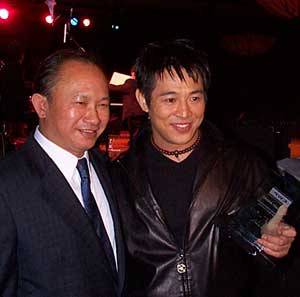 Action
Star Jet Li and
Singer Lea Salonga are
honorees by East West Players.
Action
Star Jet Li and
Singer Lea Salonga are
honorees by East West Players.
 |
|||
|
 |
|
|
| | About Us | Disclaimers and Legal Information | Advertise With Us | We welcome your comments. Send e-mail to us at info@asianconnections.com Copyright ©1999-2002 AsianConnections.com |