Stars
Honored at Golden Ring Awards,
Ask Community for Moral Support
Asian
American performers have made progress, but not enough.
By
Nicole C. Wong
Photography by Jeannie Cuan
Hollywood's cast of characters has changed for the better since actor
and producer Phillip Rhee was a youth: now, movies feature Asian Americans
as role models.
"One of the reasons I got into the film business (was) because
all the heroes that's been portrayed on the screen were everybody
other than Asian Americans," said Rhee, who was honored at the Golden
Ring Awards on Saturday. "Something was burning inside
of me, saying, 'I need to change this.'"
At the awards ceremony, Asian American performers celebrated
their progress in film, music, and other art forms while asking
the community to give its artists stronger moral support.
The Asian American Arts Foundation created the biennial Golden
Ring Awards in 1995 to recognize Asian Americans' contributions
to the arts. The third awards show, held at the San Francisco Palace
of Fine Arts, occurred in the wake of the Hispanic, African American
and Asian communities' criticism of "whitewashed" network television.
The scarcity of ethnic characters in network shows prompted
a national press conference to address the issue and a call to boycott
the networks during September.
This year, not a single television show features an Asian
American leading character, according to AAAF.
"We hope that the Golden Ring Awards is one small step to
representing the talent that we have in our community," said Jeff
Adachi, chairman of the organization's board of directors. "We know
it's there. We've got to support it. We've got to promote it."
|
 |
|
|
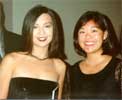
Ming
Na Wen (L) &
Nicole Wong (R)
|
|
|
That pool of talent includes actress Ming-Na Wen, who gave voice to
the character Mulan in Disney's feature animated film, starred in
The Joy Luck Club, played the lead female role in Streetfighter, and
performed in numerous television shows and theater productions.
For her strong and positive portrayals of diverse and complex
characters, Wen received the Anna May Wong award of excellence.
The award's namesake, one of the first Asian American screen actresses,
grew so bitter about the bleak future awaiting Asian Americans in
film that she quit the business in the 1940s.
"I wish she was around today to see what is happening in
this industry and how she helped to pave the way," Wen said.
Actor Lou Diamond
Phillips, a Golden Ring Award recipient whose film credits include
the lead role in La Bamba, said Hollywood suffers from "ignorance
or a lack of imagination" when it comes to casting for films.
"They don't see (it as), 'You know, this role could be Asian,
this role could be African American, this role could be Latino.'
They don't think that way," said Phillips, whose multicultural heritage
includes Chinese ancestry.
|
 |
|
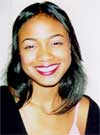
Tatyana
Ali
|
|
|
Tatyana Ali, a singer and actress who played Ashley Banks on The Fresh
Prince of Bel Air sitcom, said she turned off her television set last
year because the fall lineup didn't feature characters who represented
her.
"You are a consumer," Ali said. "You can be in control of
what you watch. That's really how things have to be changed."
In television and film, Ali has only played African American
roles. But in real life, she is of East Indian and Panamanian descent.
Ali received the Emerging Artist Award.
Most critics pointed fingers at the networks for leaving
minorities out of prominent acting roles. Yet the awards show revealed
the lack of community support for Asian American performers was
partially to blame.
"We would rather be scientists and engineers and lawyers
and all those other things," Adachi said.
Such circumstances are familiar to Golden Ring recipient
Chang Chen-Yi, who followed his heart instead of the honorable Asian
American career path. Chen-Yi's parents wanted him to become an
engineer, but he had a passion for drawing and instead became a
Disney animator who supervised the character design in Mulan.
Asian Americans need to band together in support of aspiring
artists because "art is so important to our everyday survival, to
our self-dignity, to the image that we hold of ourselves, the image
that our children will hold of who we are," Adachi said.
While the Asian American community may offer weak support,
families have been the pillars in several honorees' careers.
Chris Chan Lee, whose movie Yellow won the Best Asian American
Independent Film award, thanked his family for "their love and support
and for letting me go to film school and for not becoming what they
wanted me to be."
Music Producer Ann Carli, who help develop the careers of Will Smith
and A Tribe Called Quest and produced the soundtracks for Men in Black
and other films, credited her mother for providing advice that guided
Carli through her profession.
"You can do anything you want to. Different doesn't mean
bad. It means special," Carli recalled her mother saying.
Poet and social activist Janice Mirikitani received the Lifetime
Achievement Award. Her written work ranges from Japanese in America
to women speaking out against incest and abuse.
Mirikitani said her family's love and guidance helped shape
her career.
"When my mother broke her silence to testify about the camps
that imprisoned us during World War II, her voice commanded that
I break my silence and always fight and write against apathy and
dominion."
Dancer and choreographer Pearl Ubungen received a Golden
Ring Award for working with underprivileged communities in her art.
An excerpt was performed from her work The I-Hotel/The Fall, a 20th
anniversary commemoration of the eviction of elderly Filipino and
Chinese tenants from the I-Hotel.
 |
|
|
 |
|
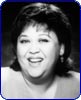
Amy
Hill
|
|
|
Comedian Amy Hill
hosted the show and award presenters included actor James Shigeta,
actress Miika Taka, actor Robin Shou, actor Gedde Wantanabe, actor
Dante Basco, model Rick Yune, writer Ben Fong-Torres and San Francisco
Mayor Willie Brown.
The awards ceremony was punctuated with performances by hip-hop
dancers Stylelements, rap artists The Mountain Brothers, alternative
rock band Julie Plug, violinist Mia Wu, R&B vocalists One Voice,
and singer Pat Suzuki. The show also paid tribute to Charlie Low
and the Forbidden City Nightclub, the first nightclub to feature
only Asian American entertainers.
--------------------
Nicole
C. Wong is a junior at U.C. Berkeley majoring in business administration
and pursuing a career in journalism. Over the summer, she
reported for the Rochester (N.Y.) Democrat and Chronicle as a Dow
Jones Newspaper Fund Business Reporting Intern. She also has
written for AsianWeek and the San Francisco Chronicle. Wong serves
as a board of directors student representative for the Asian American
Journalists Association's San Francisco Chapter and works for fair
and accurate media coverage of Asian Pacific communities.
Jeannie
Cuan is a marketing professional, and enjoys doing photography on
her leisure time.
She received her B.A. in Mass Communications from UC Berkeley.
|