Ads used to be here |
 |
 |
 |
 |
 |
 |
 |
 |
|
Life
Lessons from a DJ and a Songwriter |
||
|
AsianConnections is proud to present the adventures of Ben Fong-Torres, our very own Renaissance man: author, broadcaster, and former senior editor and writer at Rolling Stone Magazine. This guy's our hero! Ben was a featured character in the movie "Almost Famous," the Oscar and Golden Globe-winning film by Cameron Crowe. I have a friend - I'll call her "Suzanne Joe Kai" - who's always telling me that she's got stage fright. She's a successful businesswoman, a former San Francisco TV journalist who now runs a top-flight and still-growing Asian-American Internet portal. She's constantly on the go, making presentations and speeches, and appearing on panels around the country. In front of the mike, she's poised and articulate. And yet, she insists, she's freaked. Oh, OK. I guess, to a certain extent, we're all nervous about speaking in public. My theory is that you should be; a little nervous energy gives you an edge, and keeps you from being so relaxed that deliver a speech by rote, like some airline attendant describing the cabin's safety features for the millionth time.
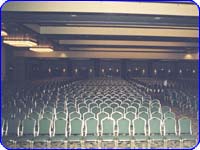
People who see me just before a panel or a talk, a radio or a TV show, think I'm pretty calm. They should've seen me the other evening, when I was about to do the keynote speech for a national conference of high school journalists. I walked into the ballroom at the San Francisco Marriott at 7 p.m., a half hour before my scheduled talk, and saw a field of seats - 2,000, at least. They were lined up perfectly, like so many grapevines, and they were empty. I panicked. Here they were, these several thousand kids, on their first evening into San Francisco. They were downtown. It was dinner time. They were with friends. And they were going to come and listen to a speech? With a vision of all those chairs remaining pristine and untouched, I wanted to go home. I felt horribly responsible for what was going to be an embarrassment for the Journalism Education Association and the National Scholastic Press Association.
I disappeared for awhile, and when I returned, the room was almost full, with students and teachers still rolling in. I looked around the cavernous room, now filled with chatter. I felt absolutely calm. That may be because I had an opening line set. That, I believe, is the key to combating stage fright. Get past that first remark, get a laugh, and you�re rolling. So after I was introduced, I told the audience that I needed to make an update on my name. "In light of some recent, earth-shaking events-namely, her name change from Jennifer Lopez to J-Lo, and, more recently, Puff Daddy becoming P. Diddy, I am no longer Ben Fong-Torres. Please call me "B-Fo." And that was it. We were on our way. Oh, yes - here's another tip. Be impromptu. When I looked out into the crowd and saw one of the biggest I'd ever faced, I was amazed, and said so. In fact, I said, I wanted a memento of this moment, so I asked a front-row student holding a camera to jump up on stage and shoot the audience. I asked the audience to smile. Flash! And, again, it was going to be all good. As for what I said to the aspiring writers, photographers and artists in the audience, it was the same old crap I've been laying out at schools and seminars for years. I did begin by exploiting the thing that probably drew so many of the students into the ballroom: the film, "Almost Famous," in which an actor plays me, circa 1973, when I was an editor at Rolling Stone. A lot of the kids had seen it, now that it was out on video. So I showed the clip of my first conversation with the main character, based on director Cameron Crowe when he was all of 15. The point, of course, was that it was indeed possible to get a call-and an assignment -- from Rolling Stone when you were still going to high school. How to make that possible...well, that's where the same old same old came in. Of course, for young people, it may be new. And for some people, you can't offer nuggets of wisdom - or whatever it is I've had in my head all these years - often enough. Here, bottom line, is what I told the students: At Oakland High School, I picked up some advice from a Top 40 disc jockey on my favorite station, KEWB, Color Radio, Channel 91. Gary Owens, who became famous as the announcer on Laugh-In, was my favorite DJ, and when I managed to land a summer job there in 1961, pulling college football scores off the wire machine and setting them up for the Saturday newscaster, I met him. One day, we spoke about my ambitions. He knew that I loved radio, that, like many kids, I harbored fantasies about doing what he was doing. Gary knew that success in radio was a difficult goal, and he told me that, as much as I loved radio, I shouldn't concentrate only on that industry. Take liberal arts, he said. Learn a bit about as much as you can-history, literature, science-so that you'll be ready for whatever comes your way. And that's pretty much what I did. The other advice, such as it was, came later. Here's how I relayed it in my speech: "I've been asked about pivotal moments in my college life. It's my belief that you make your own moments. Here's a quote that has stuck with me over the years. 'If you don't take a chance, you ain't got a chance.' I'm not sure who came up with it, but a friend told me she heard it from Bobby Neuwirth, singer, songwriter, and buddy to Bob Dylan, Kris Kristofferson, and many others." A simple idea, but one that resonates. I had a chance to meet Neuwirth at last year's South by Southwest music conference in Austin. He was wondering about whether or not he should take on a producers role in a documentary about the making of this new film by the Coen Brothers, "O Brother Where Art Thou?" He wasn't sure he was ready for the assignment. What an opening. I leaned over to him and said, 'I heard somewhere: if you don't take a chance, you ain't got a chance.' What could he say? I concluded my talk by adding: "Stay curious. Stay true to your goals, but be flexible. Don't be rigid: about yourself or about politics, or about people, or about technology, the economy, or anything else. Although you have chosen to write about people and events, don't be detached. Participate in life. Don't live through your notebook, your tape recorder, your camera." "Learn from your work and apply those lessons and insights to the most important assignment, the most important story of all: your own life." "I've done it, and I hope that you will, too." Epilogue: That bit about "Suzanne" and her stage fright? As a certain mobster on HBO would say, feggetaboutit. I just shared a podium with her at a fundraising gala for the Chinese Historical Society, and she...well, she aced it. Afterwards, she still claimed to have been nerve-wracked. But from what people in the audience said afterwards, it wasn't apparent. She was perfect. So maybe that's her formula: Say you're nervous, over and over again, until you take possession of that bundle of nerves. Drag it on stage with you. Then set -- or kick -- it aside, and take care of business. That bundle, it may turn out, is just a friendly, mental accomplice.
|
||
| For more insights by Ben, visit his official website at www.benfongtorres.com |

 |
|||
|
 |
|
|
| | About Us | Disclaimers and Legal Information | Advertise With Us | We welcome your comments. Send e-mail to us at info@asianconnections.com Copyright ©1999-2002 AsianConnections.com |