Ads used to be here |
 |
 |
 |
 |
 |
 |
 |
 |
|
Shakin'
It Up at Harvard |
||||||||
|
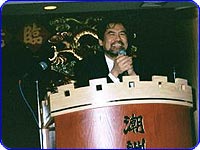
AsianConnections is proud to present the adventures of Ben Fong-Torres, our very own Renaissance man: author, broadcaster, and former senior editor and writer at Rolling Stone Magazine. This guy's our hero! Ben was a featured character in the movie "Almost Famous," the Oscar and Golden Globe-winning film by Cameron Crowe. Asian lawyers don't dance. Now, I know that�s a generality, and, knowing lawyers, I�ll get sued for saying it. But it wasn�t me who made that observation. It was Arista, the New York City actor and writer, sitting at the Infinity, a dance club in Boston�s Chinatown. We�d just come from the banquet at Chau Chow City that had closed out the 7th National Asian Pacific American Conference on Law and Public Policy, organized by the APA Law Students Association (from Harvard Law School) and the Asian American Policy Review. Sounds dry, I know, and most of the day-long conference at the John F. Kennedy School of Government in Cambridge was dedicated to serious matters, like the Wen Ho Lee case and issues facing APAs: labor challenges, technology, immigration, and politics.
But the organizers wisely included arts in the mix. The banquet keynote speaker was David Henry Hwang, the noted playwright. And one of the best-attended panels was �Escaping the Shadow of Fu Manchu: The Struggle to Reconcile Professional and Social Duty in the Arts," which I had the pleasure of moderating. And then there was the dance. Time to break it down and bust a few moves, hey? Maybe not. A half hour after people, most of them Harvard and other area students, had arrived, not one foot had yet been set on the dance floor, despite booming techno and dance music washing over all of us. Arista, who�d been on my panel, said she�d appeared at another lawyers function in New York. It was the same thing. Lots of great music; no dancing.
Could it be that the only booty-shaking Asian attorney on earth is Ling, on Ally McBeal? It wasn�t as if lawyers and law students weren�t expressive. Organizers were screeching in joy at the successful end to a year of labor, putting this conference together for more than 300 attendees from around the country. They drank, dashed around to chat and take pictures. Lotsa hugs and kisses. But, as Sinatra put it, the dance floor is empty. What was it? Are lawyers just too uptight to strike a pose? Or to shake their groove things in front of peers? Is it a lawyer thing or an Asian thing?
Well, things did change after another hour. Upstairs, a band began playing, and couples began taking the floor. But I couldn�t help noticing that one of the first was Esther Hwang, the model-actress who�s no stranger to AsianConnections, and who was also on our panel, and her beau, John. Soon, up on the stage, there were four of the conference organizers, all women, most of them law students, working out with abandon. There may be hope for Asian American attorneys yet. The conference was called "3 Ways of Looking at a Blackbird," the title of a poem and an acknowledgment of the diversity that exists under the APA designation. Which brings us back to Esther, whose swimsuit calendar offers 12 ways of looking at this intriguing blend of vivacious sex kitten and city government staffer, film producer and entrepreneur.
Along with Esther, filmmaker Greg Pak (Asian Pride Porn), actor and activist Christine Toy Johnson (a regular on One Life to Live) and Arista made up what I told our packed room was �the best-looking damned panel at this conference." It was also one of the best spoken, as the group tackled the questions many APA artists face: Is it their duty to represent their community in a positive light? [For a report on who said what, check out the article by my friend Kathleen Mackay.] The panel agreed that artists do have a responsibility to their community and their culture. They articulated the difficulties they faced in a competitive, bottom-line industry. And when I asked for solutions, they gamely tried to come up with a few. Greg Pak said the audience had to be there to support Asian American works. Those in power-as directors and producers-have to employ fellow Asian Americans, both in the cast and crew. Faced with demeaning roles and requests, artists have to listen to their hearts. As David Henry Hwang later noted in his talk, it�s not stereotypes that are the problem. It�s the very idea of stereotyping people. Like, for example, saying that Asian lawyers don�t dance. Am I glad that I was proven wrong on that one. I mean, Arista.
|
||||||||
| For more insights by Ben, visit his official website at www.benfongtorres.com |



 |
|||
|
 |
|
|
| | About Us | Disclaimers and Legal Information | Advertise With Us | We welcome your comments. Send e-mail to us at info@asianconnections.com Copyright ©1999-2002 AsianConnections.com |